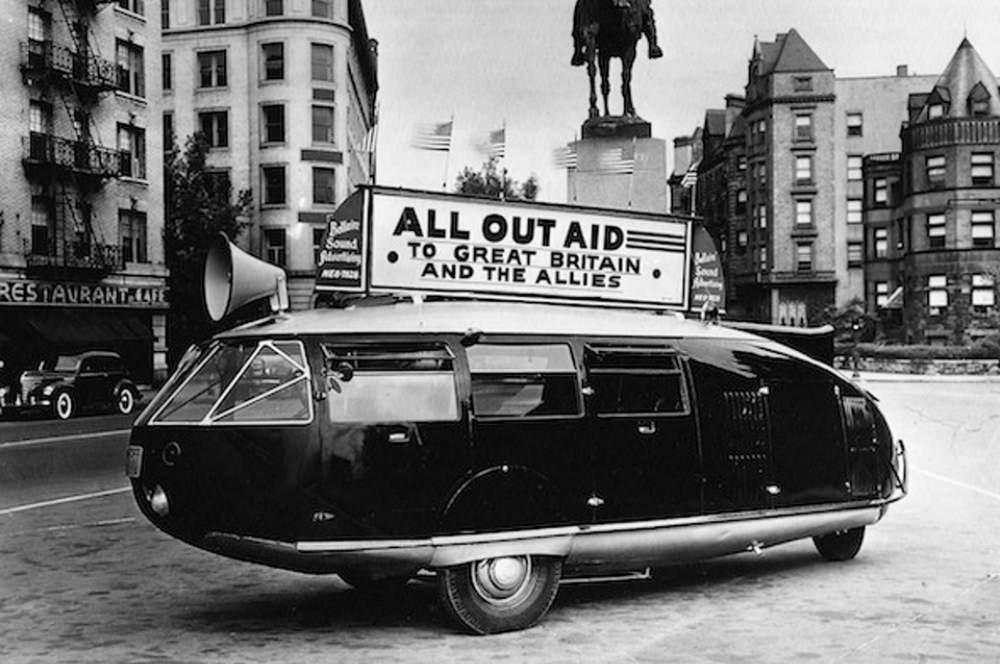
Few automotive experiments look as audacious as the 1939 Schlörwagen, a German streamliner whose bulbous, teardrop body seems to ignore the usual rules of car design. The smooth shell wraps almost completely over the wheels, narrowing toward the rear in a way that clearly chases one goal: cutting air resistance to the absolute minimum. Even standing still, it reads like a rolling wind-tunnel lesson—part passenger car, part aerodynamic provocation.
Look closer and the oddities multiply: a tiny, slanted windscreen; a long side window band punctuated by doors; and a wide, low stance that makes the vehicle appear more like a grounded aircraft fuselage than a sedan. The photograph also hints at how such a machine was presented to the public, with prominent signage mounted on top—an attention-grabbing billboard that turns the already-unusual prototype into a moving spectacle. Surrounding city buildings and street details provide scale, emphasizing just how large and unconventional the Schlörwagen’s silhouette really was.
For readers interested in historic inventions, the Schlörwagen is a reminder that the path to modern efficiency is littered with daring dead ends and brilliant misfits. Streamlining promised speed and fuel savings, yet practicality, production constraints, and shifting priorities often decided which ideas survived beyond the prototype stage. This post explores why this ultra-aerodynamic German car still fascinates collectors, engineers, and design historians—even as it remains a famous “what-if” from the late 1930s.