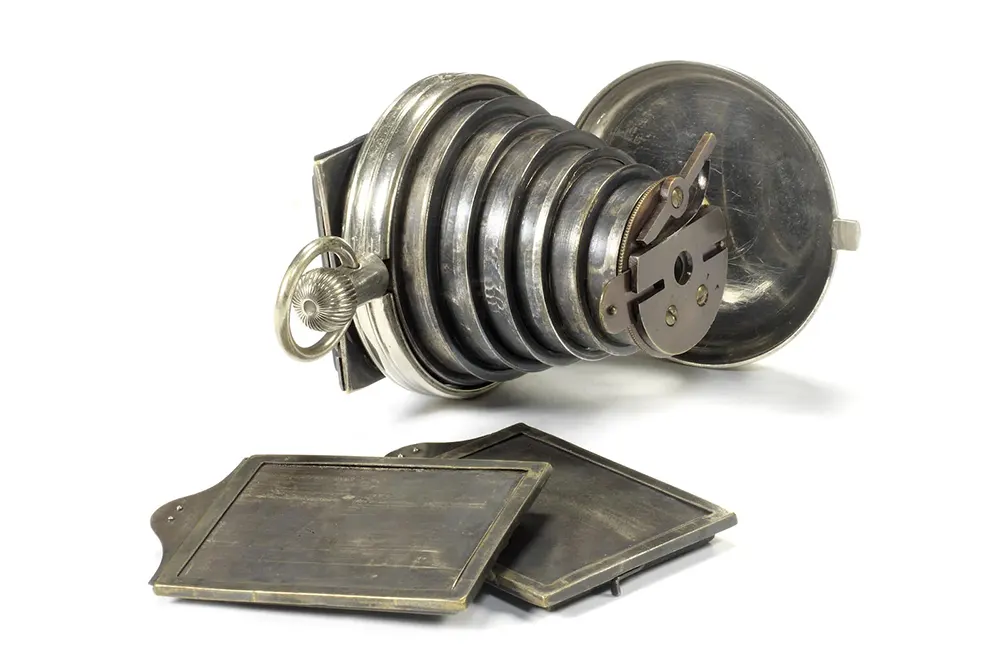
Folded metal rings stack like an accordion, turning a watch-sized body into a working bellows, while a hinged lid sits open to reveal the compact mechanism within. In the foreground, two thin rectangular plates lie beside the device, hinting at the photographic process it was built to serve. Even without a hand for scale, the Lancaster Watch Camera’s proportions read as deliberately discreet—an object that could pass as an everyday timepiece until the moment it became a camera.
Victorian inventors loved hiding complexity in familiar forms, and this pocket camera embodies that late-19th-century fascination with miniaturization and clever disguise. The combination of polished casing, collapsible bellows, and tightly packed fittings suggests an era when photography was becoming more portable yet still demanded precision engineering. It’s easy to understand how such a gadget earned a reputation as a “spy tool,” not because it belongs to any single intrigue, but because it made candid image-making newly plausible.
For collectors and curious historians alike, the 1893 Lancaster Watch Camera stands at the crossroads of horology-inspired design and early portable photography, a reminder that innovation often arrived disguised as convenience. The surviving parts shown here—body, bellows, and plates—invite questions about how exposures were made, loaded, and protected in a world before roll film dominated. As a historical photo subject, it’s a striking, SEO-friendly emblem of Victorian inventions: compact cameras, concealed technology, and the restless ingenuity that turned pocket curios into working instruments.