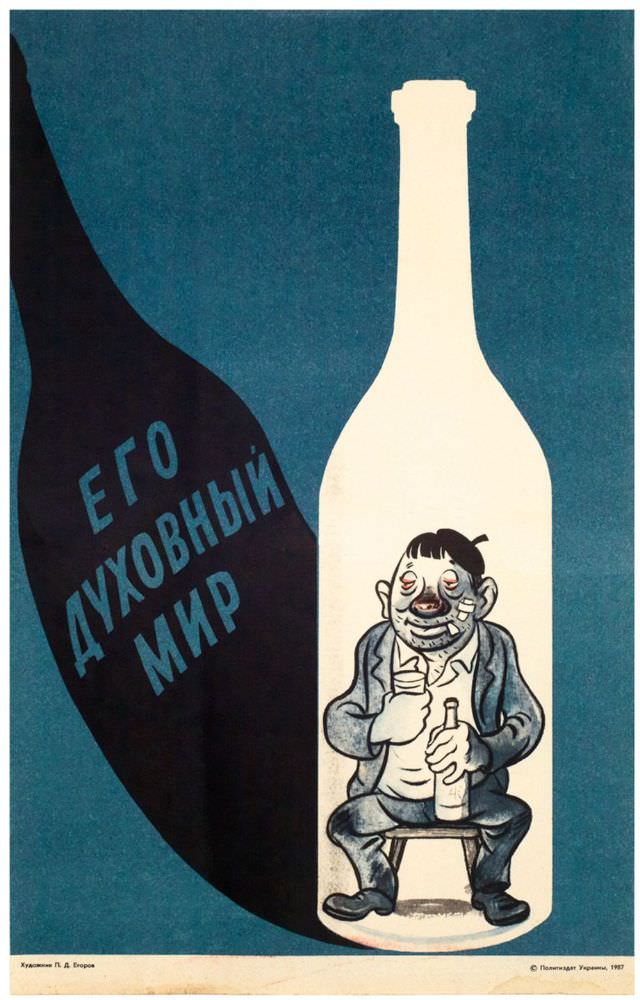
A stark bottle silhouette dominates the composition, turning a simple outline into a stage for the title’s bitter irony: “His inner world.” The Cyrillic text “ЕГО ДУХОВНЫЙ МИР” (“His spiritual world”) looms like a shadow, while the palette and clean poster-style shapes point to a late–Cold War visual language where symbolism did the heavy lifting. Dated 1987, the artwork reads immediately as a social critique wrapped in graphic wit.
Inside the bottle sits a rumpled, weary-looking man on a small stool, clutching drink in one hand and a bottle in the other, his posture slack and resigned. The caricature exaggerates features—puffy eyes, a flushed nose, heavy-lidded fatigue—suggesting how addiction narrows life until the “inner world” becomes a confined chamber. The bottle’s white boundary acts like both frame and prison, an elegant visual metaphor that makes the message unmistakable without needing a single scene beyond the figure.
Seen today, this 1987 illustration functions as both period artifact and timeless warning, the kind of poster art that could hang in a workplace corridor or public institution to spark conversation. It reflects how late Soviet-era graphic design often fused moral instruction with sharp satire, using minimal elements to deliver maximum impact. For readers searching for historical poster art, anti-alcohol messaging, or Soviet-era social commentary, “His inner world.” offers a compact, haunting example of how a society tried to picture private despair in public terms.