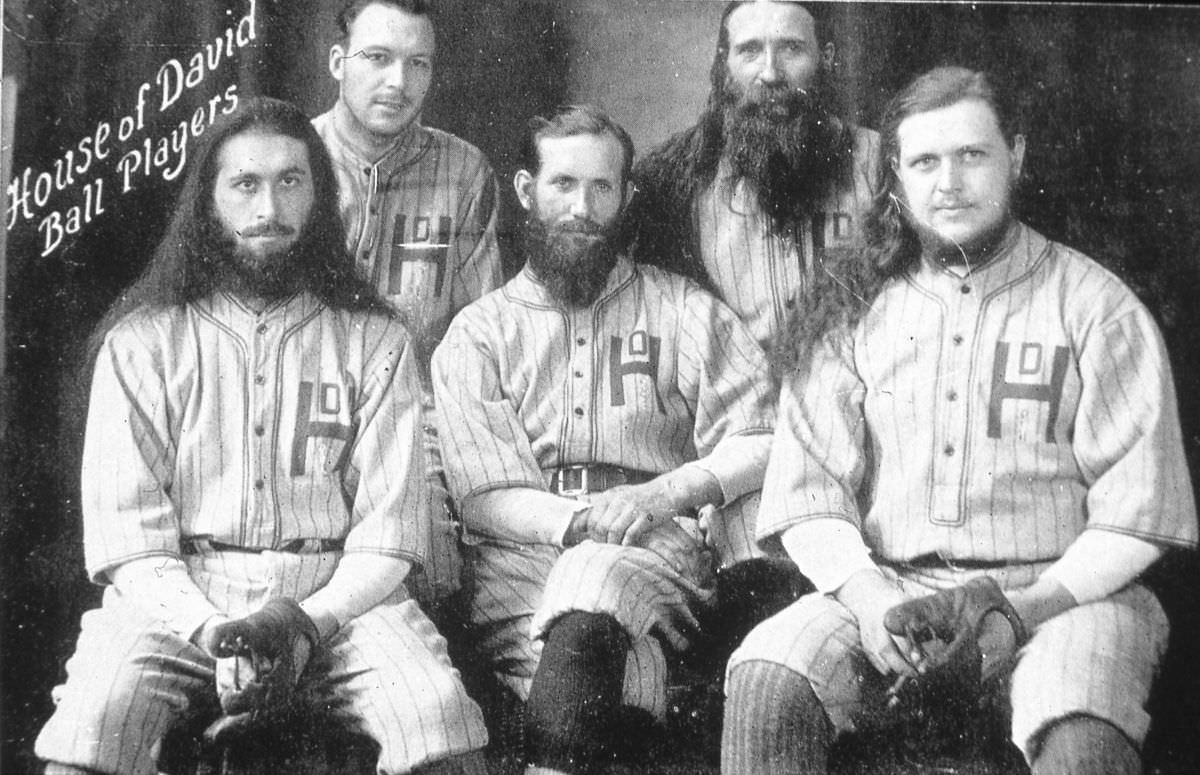
Across the top-left corner, the caption “House of David Ball Players” frames a posed team portrait that’s hard to forget. Five men in pinstriped uniforms sit and stand close together, their jerseys marked with a bold “H,” while gloves and hands rest calmly in the foreground. What draws the eye first is the striking contrast of grooming and style—several players wear long hair and full beards—giving the lineup an unmistakable identity before a single pitch is thrown.
Behind the novelty, the photograph hints at a well-drilled barnstorming outfit built for travel, publicity, and performance. Teams like the House of David blended solid baseball fundamentals with crowd-pleasing showmanship, leaning into a look that turned every appearance into an event. In that way they’ve often been remembered as a baseball counterpart to the Harlem Globetrotters: athletes who understood that entertainment could be as powerful as the scoreboard.
For readers exploring early 20th-century American sports culture, this image offers a window into how baseball teams marketed themselves long before modern branding and social media. The uniforms, the lettering, and the players’ composed expressions speak to professionalism, while the distinctive hair and beards signal a deliberate persona meant to spark curiosity in every town they visited. It’s a vivid reminder that the history of baseball isn’t only about leagues and records—it’s also about touring teams, spectacle, and the many ways the game met its audience.