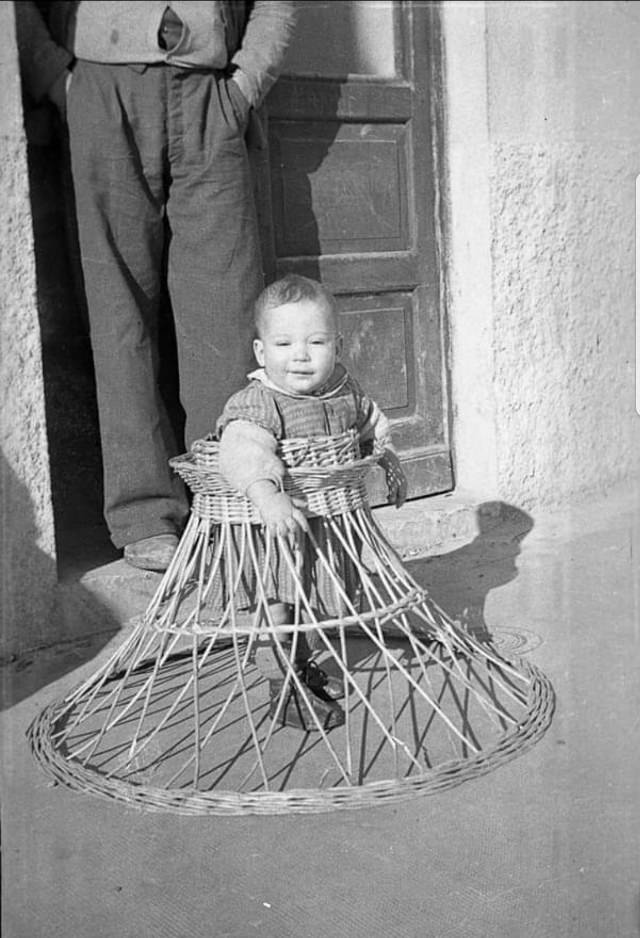
A small child stands at a doorstep, grinning as a wide wicker frame circles their waist like a bell-shaped cage. The woven ribs flare out to the ground, creating a protective perimeter that keeps little feet from toppling too far, while an adult’s legs linger nearby—close enough to supervise, but letting the experiment play out. Sunlight throws crisp shadows across the concrete, emphasizing the contraption’s odd elegance and the everyday setting where early lessons in balance happened.
In the early 1900s, baby walking aids ranged from simple push toys to elaborate “inventions” meant to steady toddlers and save caregivers’ backs. The wicker walker in this photo reflects a moment when household craft and practical ingenuity intersected: lightweight, airy, and meant to slide over a threshold without much effort. Its shape suggests both caution and optimism—an attempt to build a safer world at floor level, where a wobble could become a bruise and every new step felt like progress.
For anyone searching historical photos of babies learning to walk, this scene offers more than novelty; it hints at changing ideas about childhood, safety, and modern convenience. Long before today’s plastic activity centers and padded playpens, families tested solutions made from the materials at hand, trusting woven cane to act as both barrier and teacher. Look closely and the humor of the device emerges alongside its tenderness: a tiny explorer, a handmade frame, and the timeless human wish to help a child stand on their own.