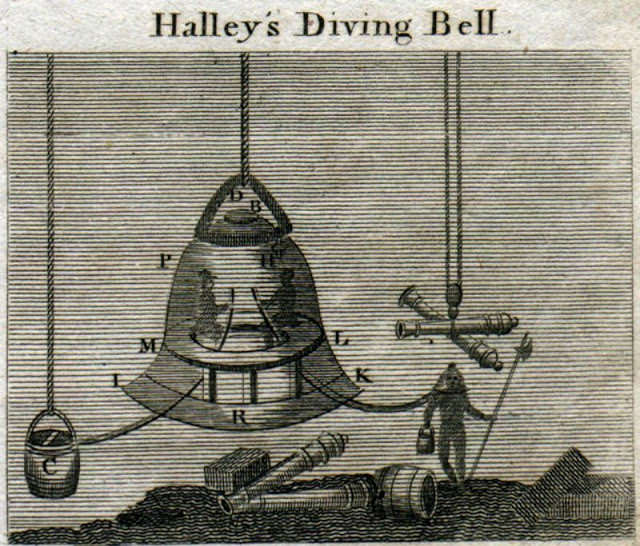
Under the bold caption “Halley’s Diving Bell,” an old engraving lays out an early vision of underwater work as engineering rather than myth. The central bell hangs from above like a suspended chamber, its curved sides marked with letters that suggest a technical diagram meant to be studied. On the seabed below, heavy pipes, barrels, and fittings sprawl across the scene, hinting at the practical challenges of sending air and supplies into a hostile environment.
Edmond Halley’s late-17th-century diving apparatus belongs to the same inventive spirit that transformed navigation, astronomy, and mechanics in this era. The bell form—part shelter, part machine—implies a simple but powerful principle: create a pocket of breathable air beneath the surface, then maintain it long enough for labor to happen. The figure shown nearby provides scale and drama, a reminder that these early experiments were designed for real bodies working in cold water, not just for display in a cabinet of curiosities.
For readers interested in the history of inventions, early diving technology, and the roots of modern underwater exploration, this illustration offers a compact story of trial and ambition. The crisp lines and labeled components make it easy to imagine how ropes, hoses, and weights would have been coordinated from above, turning the ocean into a temporary workplace. As a WordPress feature, the image pairs well with discussions of scientific instrumentation, maritime history, and the long path from crude bells and helmets to today’s diving gear.