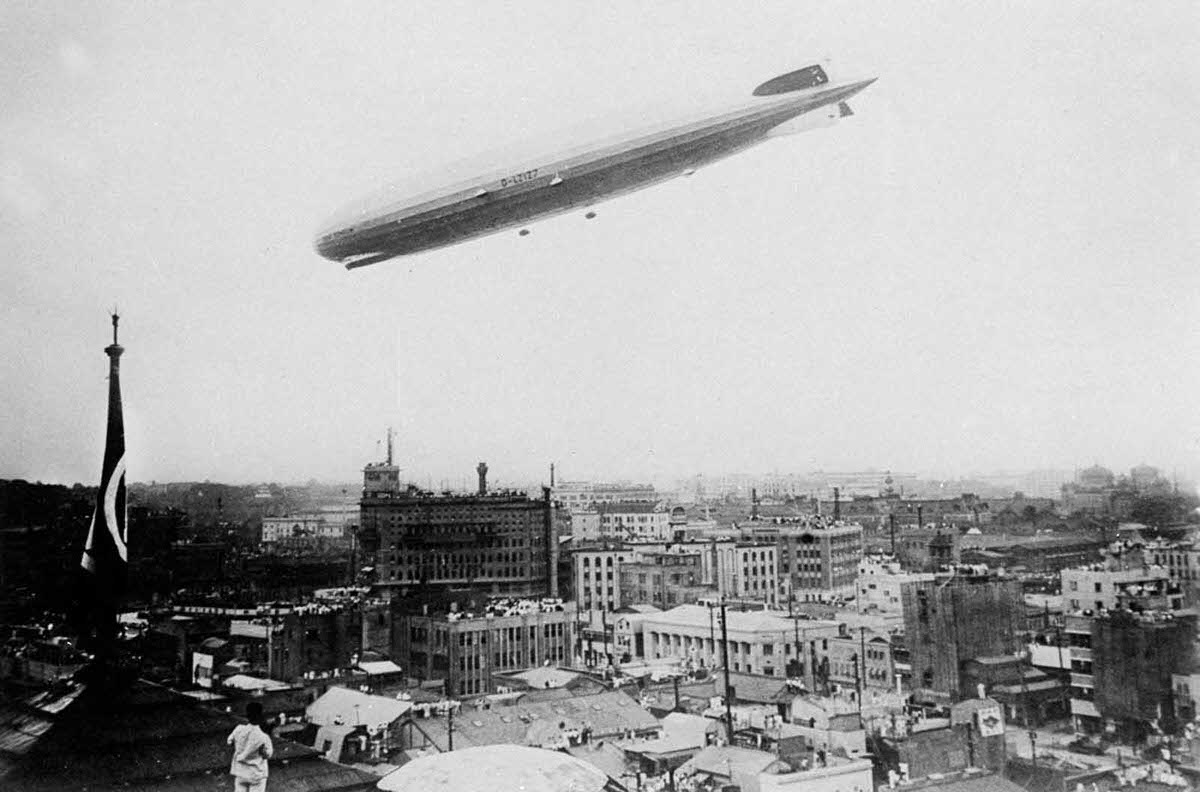
High above the crowded rooftops of Tokyo, the sleek outline of the Graf Zeppelin drifts across the sky, its long silver hull dwarfing the cityscape below. The airship’s low pass turns an everyday urban panorama—warehouses, office blocks, and a busy harbor edge—into a stage for one of the most dramatic sights of early aviation. In the foreground, a flag flutters and a lone onlooker stands near the frame’s edge, grounding the scene in the human scale that the giant dirigible so effortlessly overwhelms.
Dated August 19, 1929, this moment comes from the Graf Zeppelin’s celebrated around-the-world flight, when long-distance travel still carried the aura of a daring experiment. Unlike airplanes of the period, the rigid airship promised range, endurance, and a kind of floating steadiness, gliding in broad arcs rather than roaring past in seconds. The photograph hints at why such visits drew immense attention: technology was not just improving—it was arriving, visibly and audibly, over major cities.
After passing low over Tokyo, the Graf Zeppelin proceeded to Kasumigaura Airport, linking the metropolis to a wider global route that was reshaping how people imagined distance. For readers interested in inventions and interwar engineering, the image captures a crossroads of modernity—where industrial skylines met a new class of aircraft built for prestige, publicity, and possibility. Seen today, the airship’s shadowless glide feels almost unreal, a reminder of an era when the future seemed to hang, quiet and enormous, in the open sky.