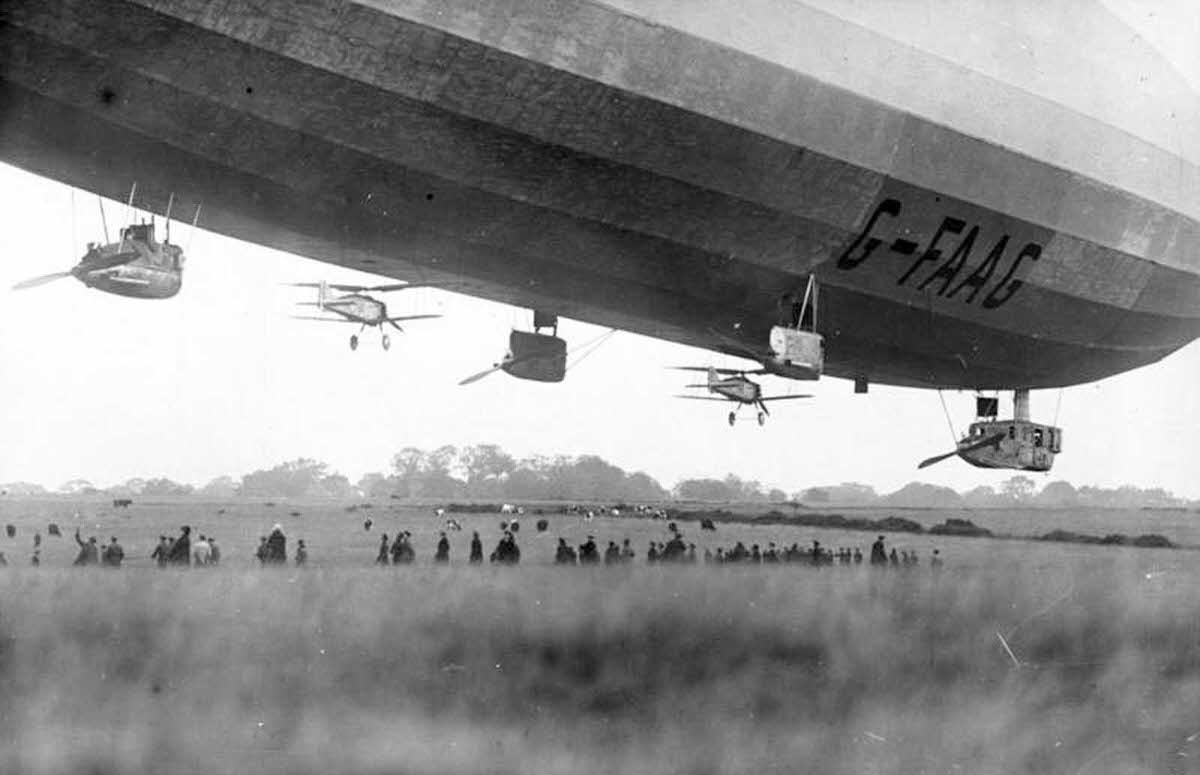
Beneath the immense belly of the British Royal Navy airship R33, two Gloster Grebe fighter planes hang in a startling display of 1920s ambition, their small biplane frames dwarfed by the rigid airship above. The registration lettering on the hull and the clustered gondolas underline the scale of the machine, while the open field below—dotted with onlookers—adds a human measure to this airborne experiment. Even at a glance, the scene reads like a bold answer to a pressing question of the era: how far could airpower be extended beyond the limits of runways and bases?
October 1926 sits in the middle of a transitional chapter in aviation history, when designers and strategists explored hybrid solutions that blended endurance with speed. Airships promised long-range patrol and the ability to loiter, while fighters offered quick interception; tethering aircraft to an airship’s underside suggested a floating platform that could deploy protection or scouting at need. The Grebes’ distinctive biplane silhouette and the careful rigging visible beneath R33 evoke the practical, hands-on engineering behind “inventions” that were tested in public view as much as in technical reports.
What makes the photograph so compelling is its balance of spectacle and experimentation: a colossal craft hovering low over pastureland, with its parasite fighters suspended like tools ready to be used. For readers interested in Royal Navy aviation, early aircraft carrier concepts, and interwar airship development, this image captures the inventive spirit that pushed aerial technology forward—even when ideas were awkward, risky, or short-lived. It’s a vivid reminder that modern air operations were shaped not only by triumphs, but by daring trials that briefly made the sky look unfamiliar.