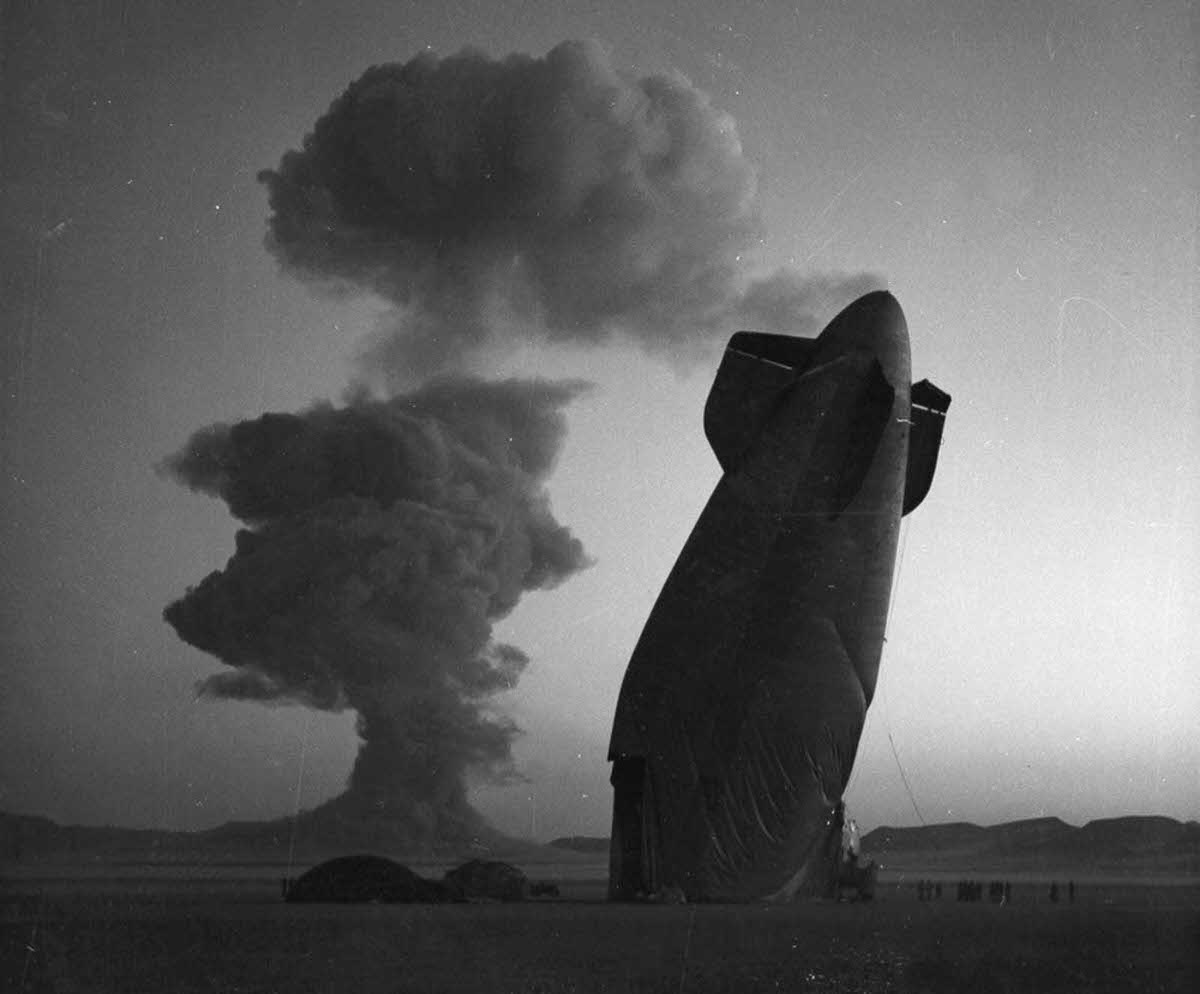
Rising like a dark, bruised pillar over the Nevada desert, the nuclear blast cloud dominates the horizon while a U.S. Navy blimp’s tail stands in the foreground like a stranded monument. The photograph’s stark contrast—open sky, low mountains, and a flat test range—pulls the eye between two kinds of power: the quiet geometry of aviation technology and the turbulent force of an atomic detonation. Taken on August 7, 1957, it freezes a moment when the Cold War’s most secretive experiments were also meticulously documented.
The blimp tail, tethered and partially collapsed, hints at the practical purpose behind such scenes: measuring effects, testing equipment, and gathering data in controlled conditions at a nuclear test site. Even without close-up details, the image suggests a carefully staged operation—small figures and ground equipment near the base emphasize scale, while the billowing cloud expands into a massive, layered canopy. That uneasy pairing of everyday military hardware with a mushrooming blast speaks to the era’s belief that science and engineering could quantify almost anything.
For readers interested in Nevada nuclear tests, U.S. Navy aviation, and 1950s military history, this photo offers more than spectacle; it’s a visual record of how atomic weapons testing intersected with invention and surveillance. The composition captures the desert as both laboratory and proving ground, where instruments, aircraft, and observers were placed in harm’s way to understand an unprecedented weapon. Decades later, the image remains a sobering reminder that technological progress often arrived shadowed by clouds like this one.