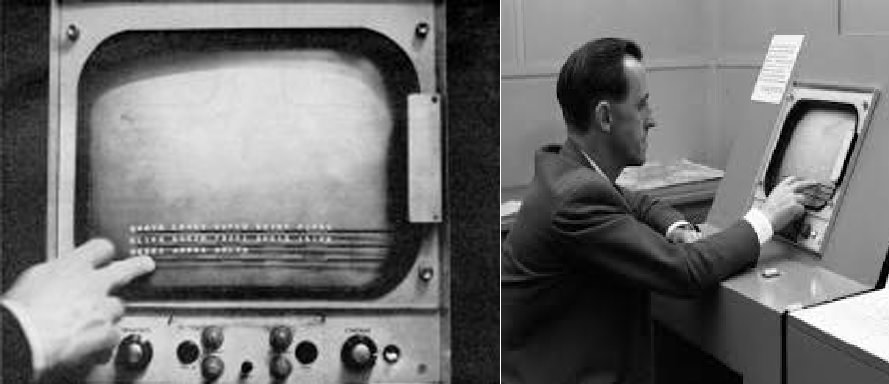
Long before smartphones turned swipes and taps into everyday habits, engineers were already experimenting with the idea of controlling a computer directly through a screen. The title points to E. A. Johnson’s mid‑1960s work on touch screens, and the photo evokes that pioneering moment when interaction shifted from knobs, switches, and keyboards to something more immediate and intuitive: the human fingertip.
On the left, a rugged, instrument-like display sits inside a thick metal frame, with control dials and indicator hardware that feel unmistakably of early computing and avionics-era design. To the right, a suited operator leans in toward a slanted console, reaching out to make contact with the monitor itself—an action that still looks surprisingly modern despite the bulky equipment and laboratory setting. Together, the paired views suggest a demonstration: interface concepts being tested in real time, where a hand replaces an intermediary device.
For readers interested in the history of inventions and user interfaces, this scene offers a clear bridge between mid‑century control rooms and today’s glass rectangles. It’s a reminder that “touch” was not an overnight breakthrough but an evolving idea, developed in environments that valued speed, clarity, and direct manipulation of information. The photo makes a compelling companion to the post title, highlighting the early roots of touchscreen technology and the design challenges that had to be solved before it could become commonplace.