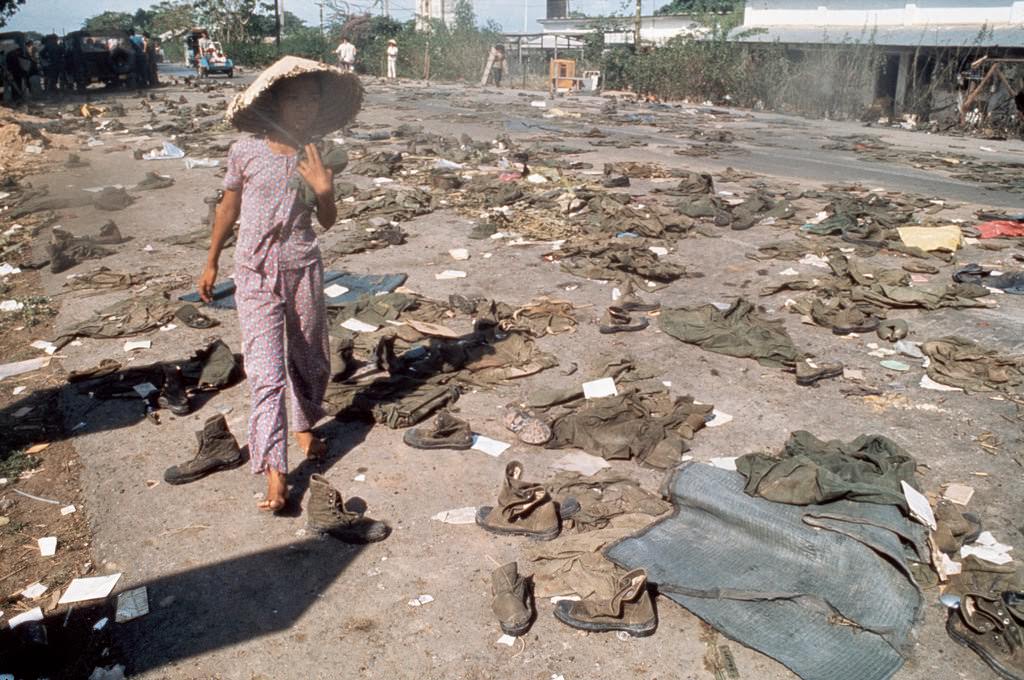
Heat and dust hang over a roadway strewn with cast-off military clothing, boots, and scattered papers, turning the asphalt into an impromptu archive of retreat. A lone civilian in a wide, woven hat threads carefully through the debris, her posture suggesting both urgency and disbelief. The abandoned uniforms—left where they fell—speak to a sudden unraveling, when order gave way to flight.
In the final convulsions of the Vietnam War and the advance that culminated in the Fall of Saigon, uniforms could become liabilities as quickly as they once served as protection. What remains here is not a battlefield tableau of weapons and formations, but the quieter residue of collapse: torn fabric, mismatched gear, personal effects separated from the people who carried them. The emptiness of the clothing underscores the human absence, hinting at soldiers who vanished into crowds, shed identifiers, or were swept away by events moving faster than any plan.
For readers searching for Vietnam War history, Fall of Saigon photographs, or images of South Vietnamese soldiers during the war’s end, this scene offers a stark, ground-level perspective. The road functions like a corridor between two realities—one defined by uniformed authority, the next by survival and uncertainty. Even without visible combat, the photograph conveys how quickly a city can change when an invasion reaches its streets, leaving behind only what could not be carried.