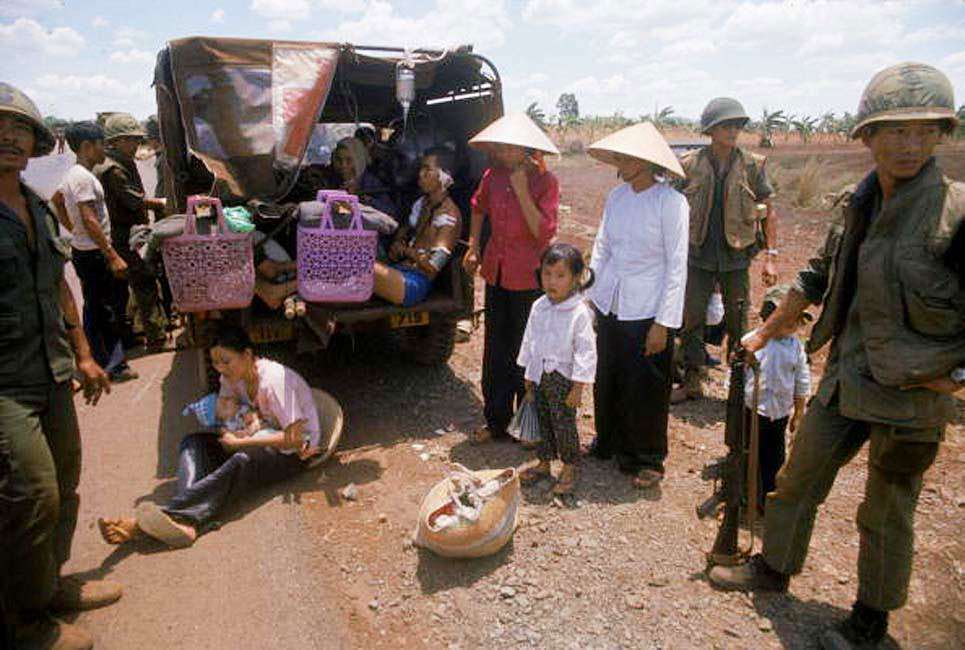
Dust and hard sunlight hang over a roadside scene as South Vietnamese citizens gather around an open-backed military truck, trying to secure a place out of danger in April 1975. Women in conical hats stand close together with children at their side, while a seated figure rests on the ground near the vehicle, suggesting exhaustion amid hurried movement. Personal belongings—bags and small bundles—signal decisions made quickly and under pressure, the essentials of a life reduced to what can be carried.
South Vietnamese troops frame the moment, rifles slung and uniforms worn, simultaneously guarding and guiding the civilians as the Vietnam War approached its final, chaotic days. Their presence adds a tense order to the crowd: a fragile corridor of protection, but also a reminder that this flight is taking place in the shadow of armed collapse. The truck, more utilitarian than comforting, becomes a symbol of evacuation—an improvised lifeline on a rural road.
April 1975 evokes the broader story of displacement at the end of the conflict, when families faced uncertain routes and uncertain futures. Scenes like this illuminate the human scale of the war’s conclusion, beyond strategies and headlines: the waiting, the confusion, the small gestures of assistance, and the visible strain on faces and bodies. For readers searching Vietnam War history and the South Vietnamese evacuation, the photograph offers a sober window into the lived experience of those final days.