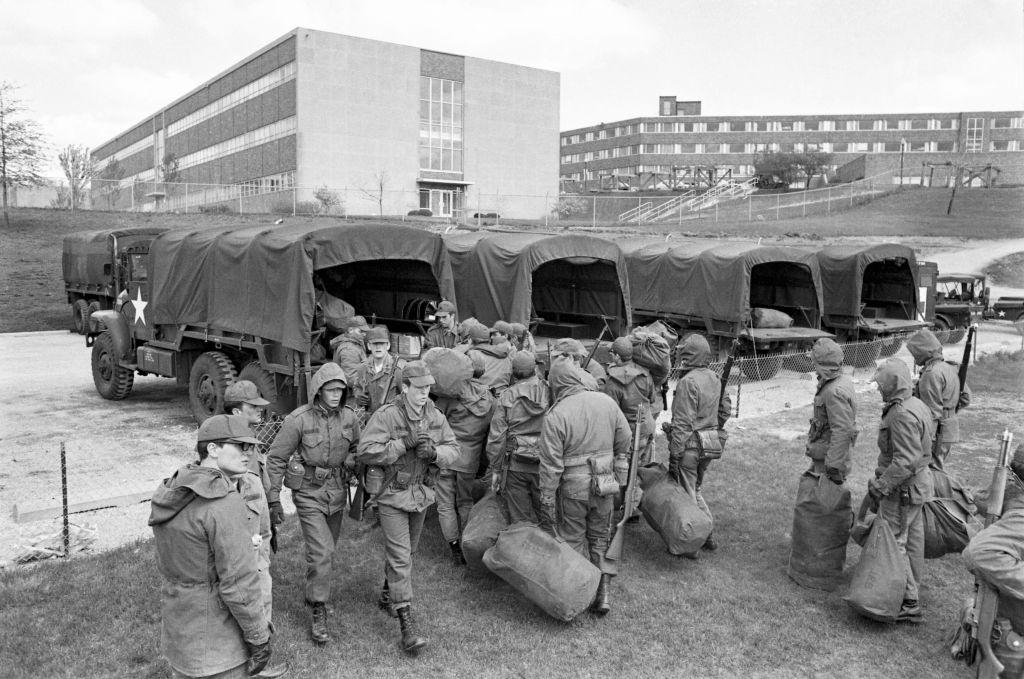
Rows of canvas-topped military trucks sit along the edge of the Kent State University campus as Ohio National Guardsmen gather their gear and prepare to move out. Helmets, heavy jackets, and duffel bags dominate the foreground, while the stark geometry of campus buildings looms behind them. The scene feels like a pause between actions—orderly, procedural, and tense in its quiet efficiency.
In the context of the Vietnam War era, moments like this speak to how quickly a college landscape could be transformed into a staging ground for armed authority. The guardsmen cluster in small groups, checking equipment and drifting toward the vehicles, their posture suggesting fatigue as much as readiness. Even without visible confrontation, the combination of rifles, transport trucks, and institutional architecture captures the unsettled atmosphere that defined so many campuses during that period.
For readers exploring Kent State history, National Guard deployment, or the broader story of protest and state power in America, the details here matter: the logistics, the uniforms, the bags slung low, and the fenced boundary cutting through the frame. It’s a reminder that the most consequential historical episodes are often built from ordinary motions—loading up, lining out, leaving—performed under extraordinary pressure. This photograph offers a grounded, documentary glimpse into that charged chapter of U.S. history.