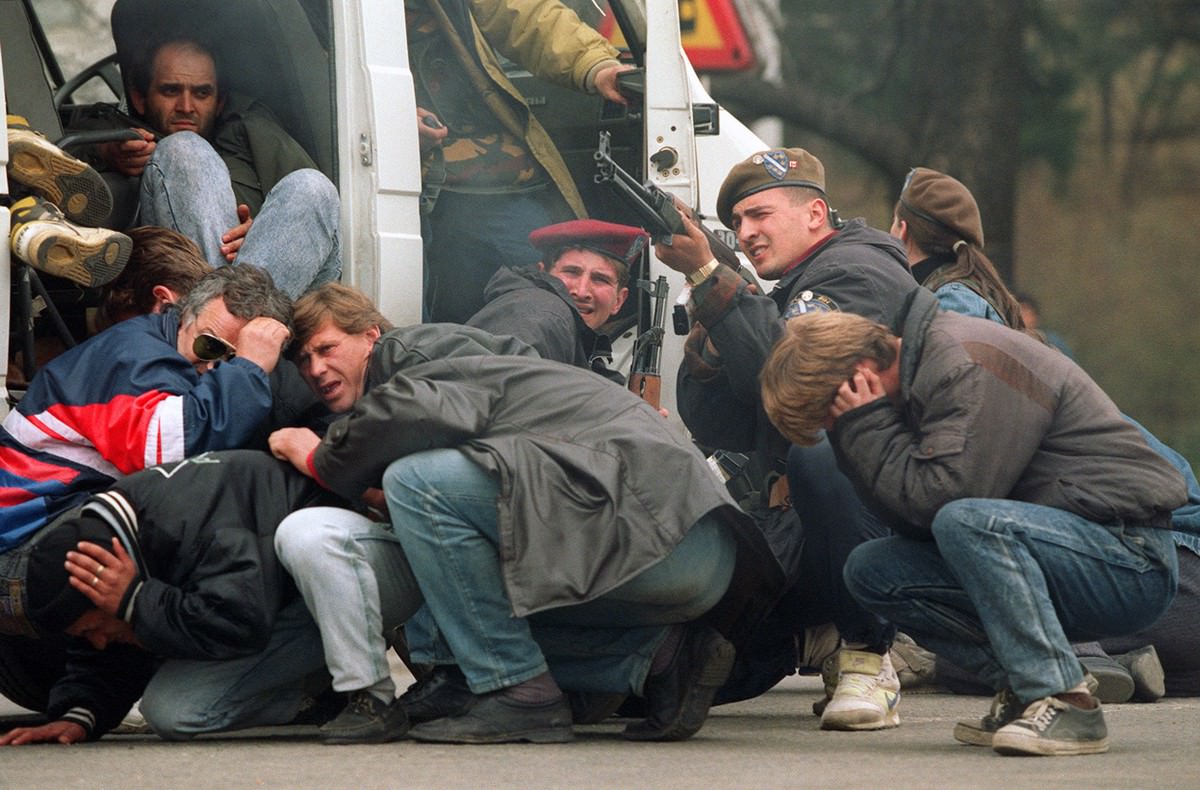
Downtown Sarajevo becomes a sudden battlefield in this searing moment from April 6, 1992, when a Bosnian special forces soldier raises his weapon and returns fire while civilians huddle at street level. Men in everyday jackets and jeans press themselves against the pavement, hands over ears and heads tucked low, using the side of a vehicle as the only available cover. The soldier’s tense posture and fixed gaze suggest how quickly ordinary urban space can turn lethal when snipers command the surrounding vantage points.
At the center of the frame, the proximity between armed defender and unarmed bystanders collapses any comfortable distance between “front line” and “home.” Faces register fear, urgency, and disbelief; bodies crowd together in a reflexive choreography of survival—crouch, shield, wait, move. Small details, from the vehicle door hanging open to the cramped cluster of legs and elbows, underline the chaos of an attack that offers no warning and little protection.
Seen through the lens of civil wars and the early days of the Bosnian conflict, the photograph speaks to the siege-era reality where civilians and fighters were forced into the same narrow margins of safety. It’s a stark reminder of the vulnerability of city dwellers under sniper fire, and of the improvised decisions made in seconds that can decide who makes it across an exposed street. For readers searching the history of Sarajevo in 1992, the image endures as testimony to how violence reshaped daily life and public space in an instant.