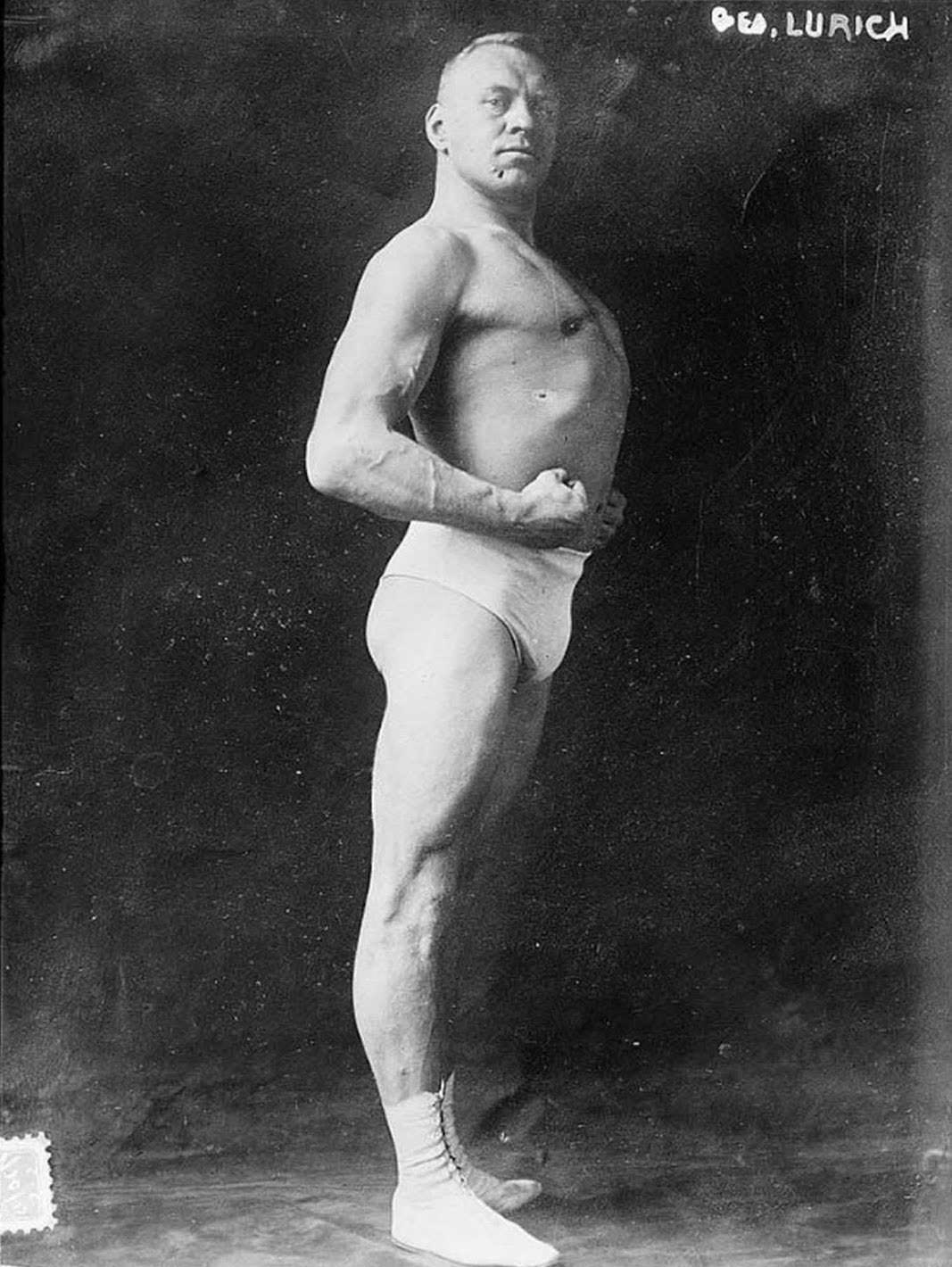
Georg Lurich stands in a studio pose dated 1910, his torso turned in profile and his arms drawn in tight to emphasize strength and control. The plain backdrop and soft, directional lighting pull attention to the sculpted lines of his shoulders, chest, and legs, while the handwritten “G. A. LURICH” at the top serves as a period marker of celebrity and promotion. Even without a bustling arena behind him, the photograph communicates performance—an athlete presenting the body as proof of discipline.
Early 1900s “strongman” culture sat at the crossroads of sport, spectacle, and emerging physical education, and portraits like this helped define what modern bodybuilding would become. The minimal costume and deliberate stance echo the era’s fascination with classical proportion, yet the overall impression is distinctly modern: a public image crafted to circulate, be collected, and inspire imitation. In that sense, the camera becomes part of the training hall—documenting and broadcasting an ideal of fitness.
For readers interested in sports history and the roots of bodybuilding photography, this 1910 portrait offers more than nostalgia; it’s a snapshot of how athletic identity was marketed before mass media took its familiar forms. The careful composition, the confident expression, and the emphasis on muscular development speak to an audience already hungry for physical culture icons. As a historical photo, it bridges the world of stage strongmen and the later era of gym-based bodybuilding, capturing a pivotal moment in the visual language of strength.