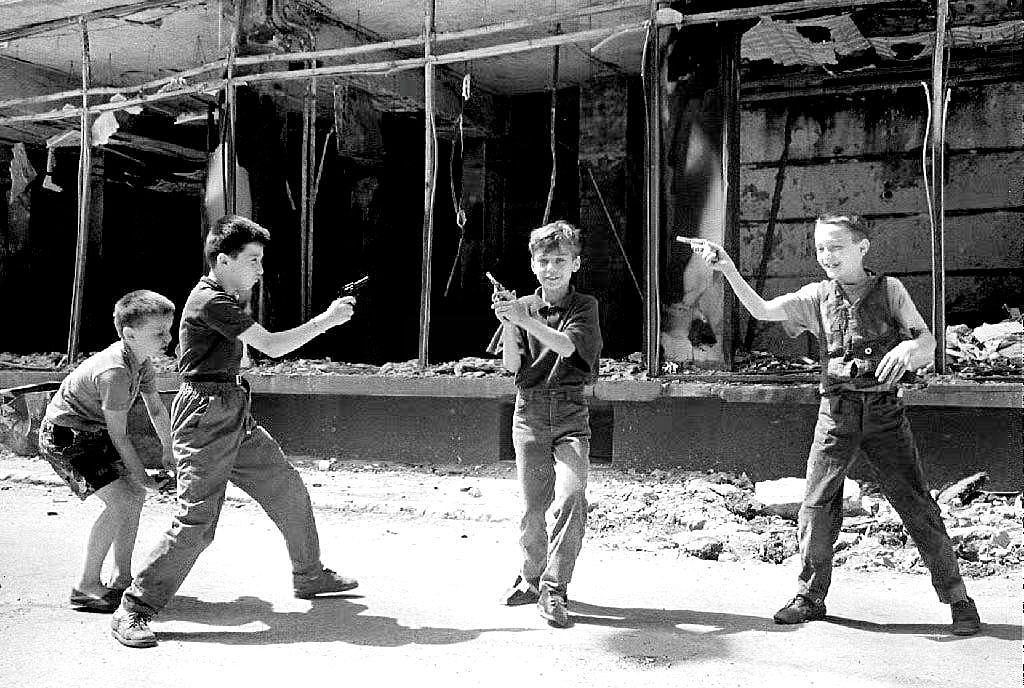
On a sunlit street in Sarajevo on 19 August 1992, four boys step into an improvised drama with toy pistols, their poses half-play, half-lesson absorbed too quickly. Behind them, a building stands gutted and blackened, its windows blown out and its interior reduced to shadow and twisted frames. The contrast is jarring: small hands mimicking authority and danger while rubble and ash linger as the real backdrop.
Ruined walls and dangling metal lines hint at recent fire and violence, yet the boys’ expressions suggest the stubborn elasticity of childhood. One crouches as if taking cover, another points with a practised stance, and two others hold their plastic weapons at the ready, turning a devastated frontage into a stage. The scene speaks to civil wars’ quiet cruelty—how conflict seeps into ordinary games, vocabulary, and gestures long before a child can name what is happening.
For readers searching the history of the Bosnian War and the Siege of Sarajevo, this photograph offers a stark, human-scale entry point into 1992’s daily reality. It captures not combat itself but its imprint: damaged architecture, open streets, and children rehearsing what they see adults do. As a historical photo, it preserves a moment when resilience and trauma occupy the same frame, reminding us how war reshapes cities—and imaginations—at once.