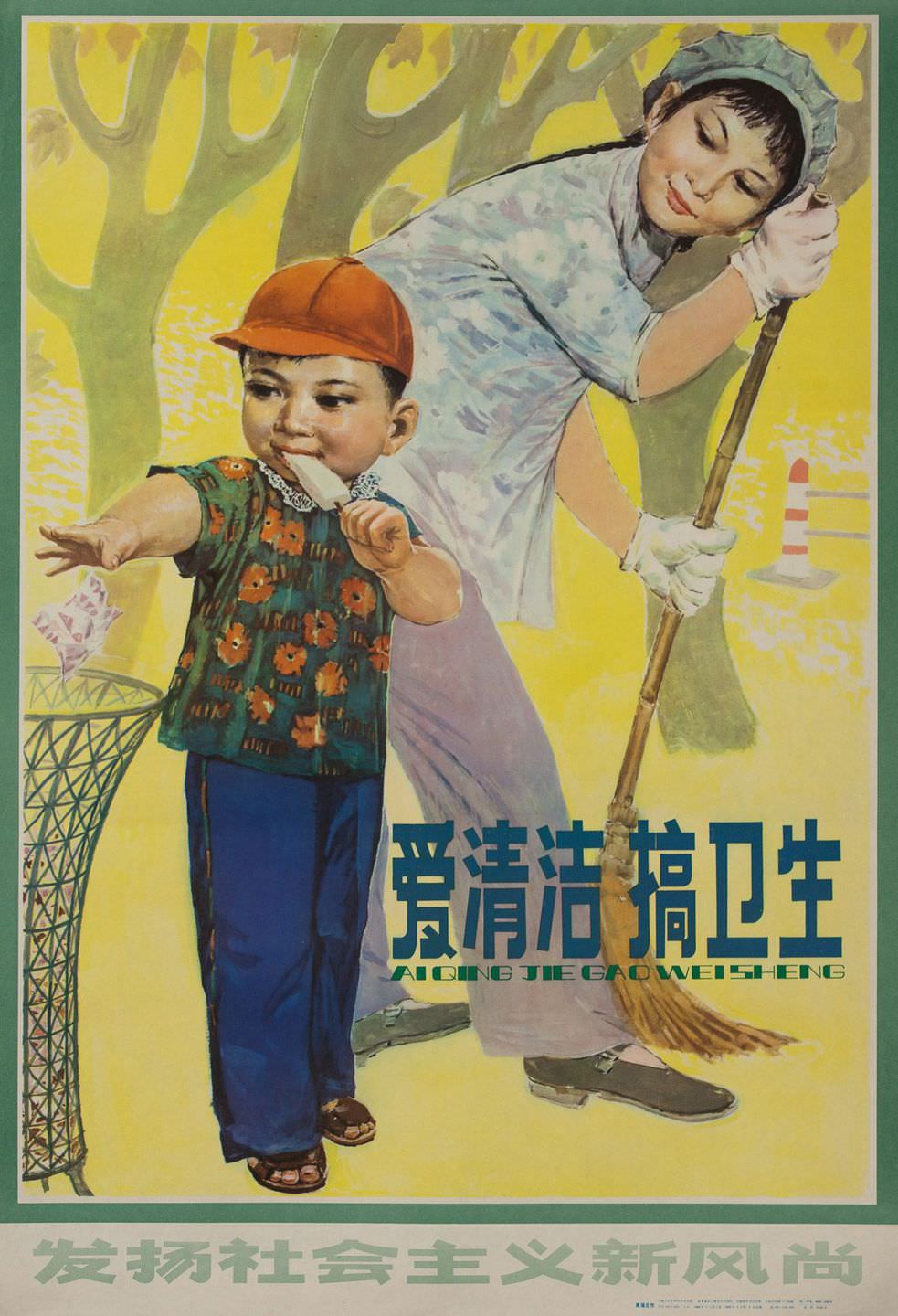
Bright blocks of yellow and green frame a public-health message in “Pay Attention to Hygiene, 1970,” an illustrated poster that turns everyday cleanliness into a civic virtue. A young child in a red cap points outward while holding a toothbrush, and behind him a smiling woman in work clothes and gloves leans on a broom—figures staged like role models in a neighborhood scene. Large Chinese characters dominate the lower portion, reinforcing the slogan-driven style typical of mass-produced hygiene and sanitation campaigns.
Details in the artwork reward a slower look: the patterned shirt, the crisp white gloves, the metal waste bin at left, and the sweeping broom all work together as visual shorthand for proper habits. Rather than focusing on illness or fear, the composition uses warmth and optimism—clean lines, friendly faces, and a light-filled background—to make hygiene feel aspirational. Even without reading the text, the message is unmistakable: brushing teeth, tidying streets, and keeping shared spaces orderly are responsibilities to be practiced and taught.
For WordPress readers interested in historical posters, public health propaganda, and 1970s graphic design, this piece offers a vivid example of how social ideals were communicated through art. It bridges the personal and the communal, pairing domestic routines with public sanitation to suggest that a healthy society begins at home and continues in the street. As an artwork, it stands as both a cultural artifact and a reminder of how visual storytelling has long been used to shape daily behavior.