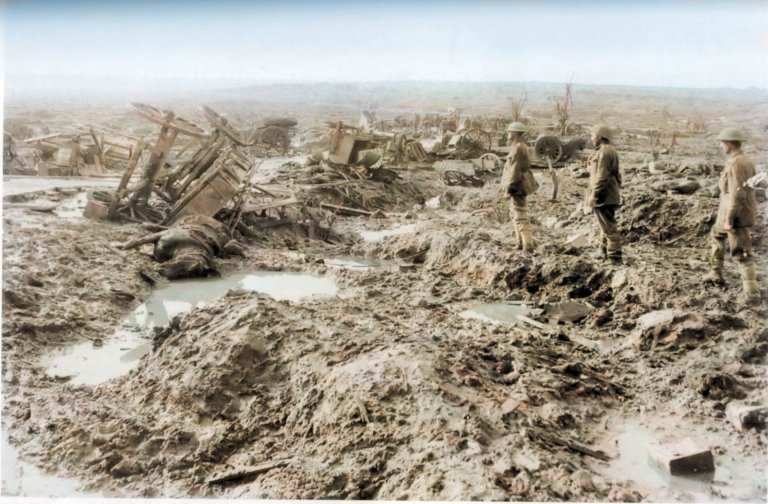
Across a churned plain of mud and standing water, three soldiers pause in silence, their figures small against a landscape torn open by war. Shell craters pockmark the ground, pooling into pale puddles, while jagged splinters of timber and twisted debris jut out at odd angles. The colorization lends a stark realism to the scene, making the wet earth and washed-out sky feel immediate rather than distant history.
Wagons lie upturned and wrecked across the middle distance, as if a supply line has been snapped mid-motion and left to rot where it fell. Broken wheels, scattered planks, and half-buried fragments suggest the violence of bombardment and the fragility of the logistics that kept armies moving. In the far background, the horizon looks flattened and stripped, reinforcing the sense of a battlefield reduced to raw ground and shattered equipment.
Seen today, the photograph reads as both documentation and warning: a record of devastation measured not in grand monuments but in ruined transport, flooded craters, and men surveying what remains. For readers searching for a colorized historical photo of soldiers on a destroyed battlefield, the details here—mud, wreckage, and the sheer emptiness—tell the story with brutal clarity. The soldiers’ stance invites the viewer to linger, imagining the noise that has just faded and the hard work of survival and recovery that must follow.