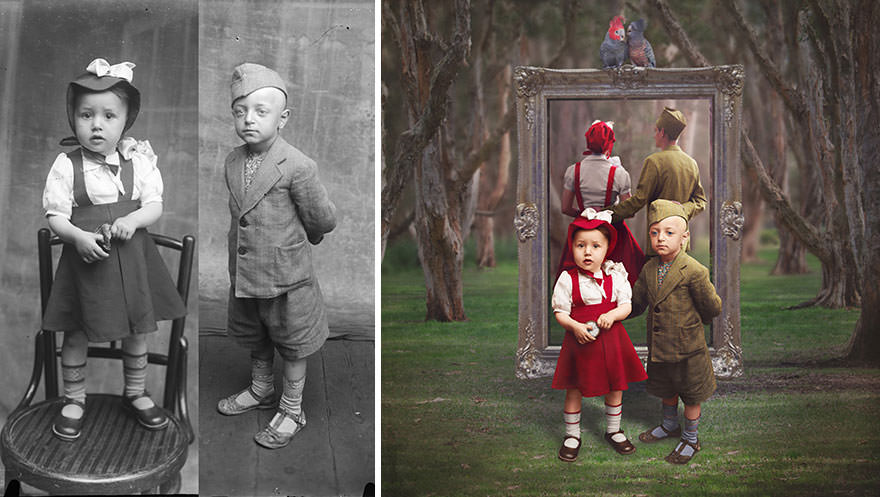
A pair of children stand in formal poses that feel both tender and solemn, their small hands and careful posture echoing the etiquette of early studio portraiture. In the original glass-plate look, the scene is spare and quiet: plain backdrops, a chair used like a prop, and clothing whose textures—wool, cotton, polished shoes—carry the weight of family pride. Their expressions are restrained, as if they’ve been instructed to hold still for the long moment the camera demanded.
Color enters as interpretation rather than mere restoration, turning the old portrait into a conceptual artwork that bridges centuries. The recoloring suggests deep reds, earthy browns, and soft skin tones, lending immediacy to details that monochrome can flatten—ribbons, straps, and the layered construction of childhood outfits. Instead of trying to “solve” the past, the artist uses color to invite a new way of looking, where memory and imagination share the frame.
An ornate frame and a wooded setting expand the narrative beyond the studio, creating a picture-within-a-picture that feels like a dream of history being carried into the present. The addition of birds perched above the frame heightens the allegory: stillness versus motion, preservation versus living time. For readers drawn to recolored vintage photography, glass-plate portraits, and artistic colorization, this post offers a striking reminder that the past can be revisited without being reduced to simple realism.