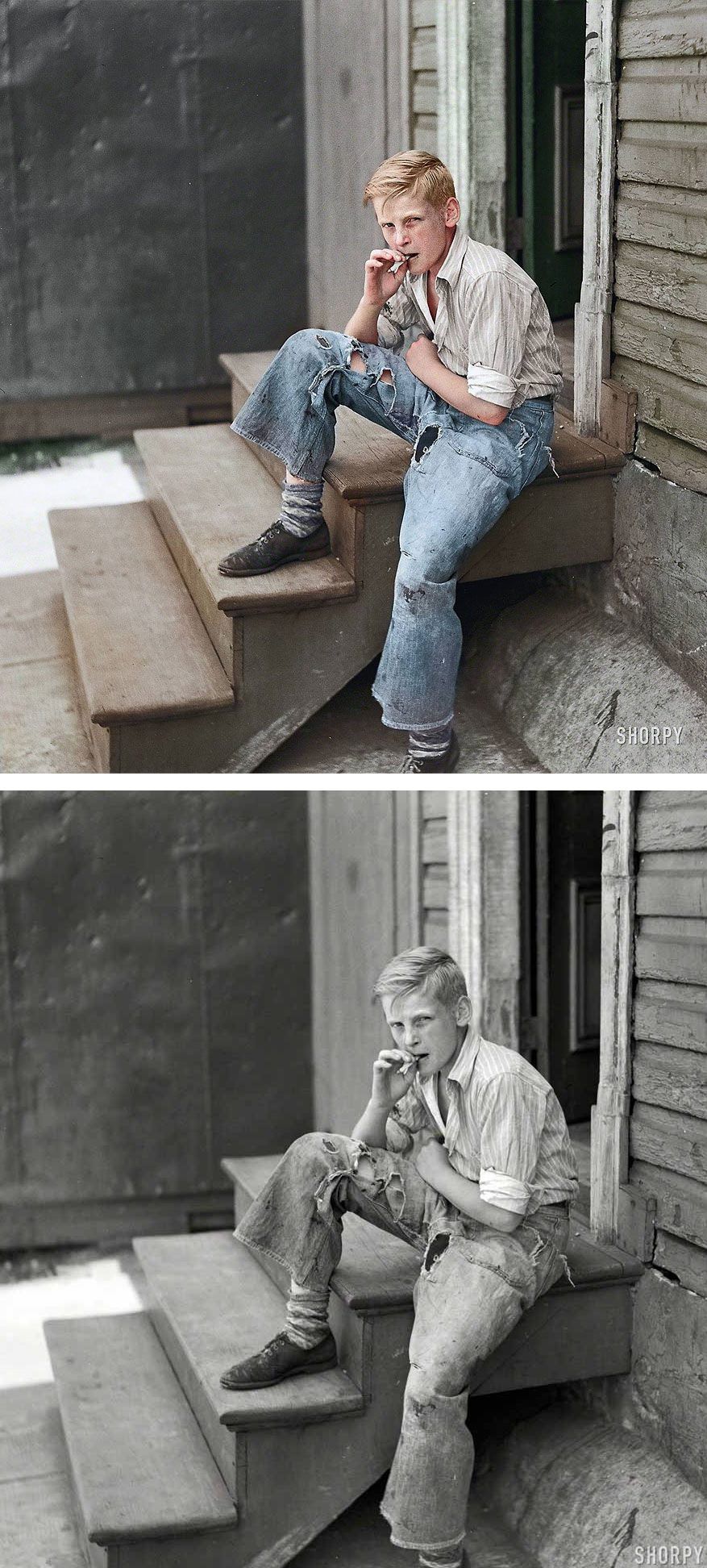
Perched on a narrow set of wooden steps, a young boy in Baltimore meets the camera with a steady, guarded stare, one hand raised to his mouth as if caught mid-thought. The worn clapboard siding and the shadowed doorway behind him frame a quiet corner of a slum area, while his rolled sleeves and loosened collar hint at summer heat and long days outside. Even without a bustling street scene, the setting feels lived-in and tight, the kind of urban space where home, stoop, and sidewalk blur into one.
Details do most of the talking: torn trousers patched by use rather than needle, sagging socks, scuffed shoes, and a posture that mixes fatigue with defiance. The colorization brings new immediacy to these textures—weathered wood, dusty fabric, sunlit skin—turning what might read as distant “history” into something startlingly present. In the boy’s expression there’s the familiar calculus of childhood in hard times, where play and responsibility often share the same small square of pavement.
Dated July 1938, the photograph sits on the late-Depression edge of American life, when poverty was not an abstraction but an address and a daily routine. Baltimore’s poorer neighborhoods were shaped by overcrowding, aging housing stock, and limited opportunity, conditions that reformers documented and that families endured with resilience. For readers searching for Great Depression era photography, Baltimore history, or slum life in the 1930s, this portrait offers a concise, unforgettable glimpse—one child, one stoop, and a city’s struggles written in everyday materials.