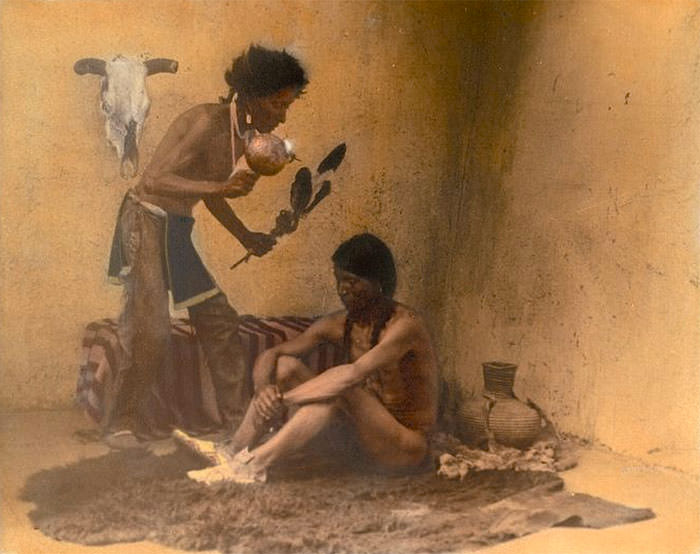
Warm adobe walls and earthen tones frame an intimate moment of care in Taos Pueblo, New Mexico, as recorded in 1905 by photographer Carl Moon and later presented here in colorization. A medicine man leans in with focused attention, holding ritual objects that suggest healing practices rooted in tradition. Nearby, a patient sits low to the ground on layered textiles, posture quiet and inward, as if bracing through discomfort while trusting the process.
Details in the room pull the viewer deeper into daily life: a striped blanket draped along the wall, a woven vessel set to the side, and a patterned rug anchoring the scene. The medicine man’s adornments and the suspended animal skull on the wall hint at spiritual symbolism without spelling it out, leaving space for interpretation. Color brings out the desert palette—dusty ochres, muted reds, and soft shadows—helping modern eyes sense texture and temperature rather than seeing only a flat past.
As a historical photo of Native American healing traditions at Taos Pueblo, this image sits at the crossroads of documentary photography and cultural memory. It invites questions about how early twentieth-century photographers approached Indigenous ceremonies, what was shared openly, and what remained private beyond the frame. For readers interested in Taos Pueblo history, traditional medicine, and early New Mexico photography, Moon’s composition offers a rare, contemplative glimpse into a moment where community, ritual, and recovery meet.