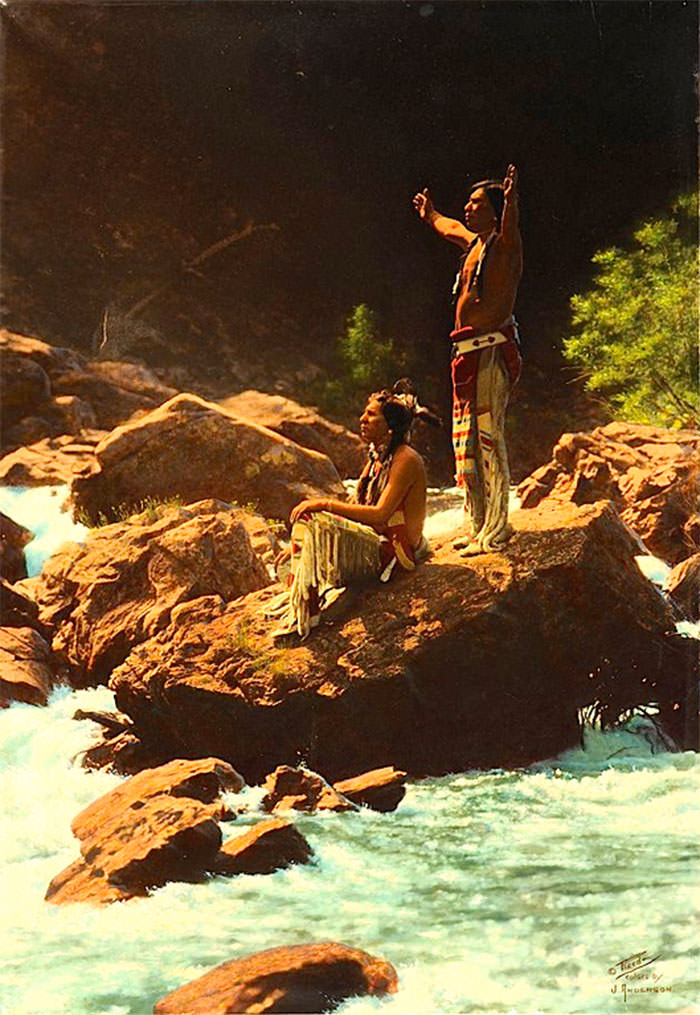
Sunlit spray and dark canyon shadow frame two Piegan men poised on river-worn boulders, one seated in stillness while the other lifts his arms in a gesture of address. The rushing Montana water below reads as both a boundary and a presence, its bright current cutting through the rock like a living voice. Details of dress—fringe, beadwork, and carefully arranged hair—stand out against the rugged landscape, giving the scene an intimate immediacy despite its age.
Roland W. Reed titled the moment as a prayer to the Thunderbird, grounding the photograph in a sacred narrative rather than a simple outdoor portrait. That context invites the viewer to consider how early twentieth-century photography often hovered between documentation and staging, and how Indigenous ceremony was frequently filtered through a non-Native lens. Even so, the composition emphasizes reverence: bodies turned toward open air and sky, attention drawn upward, with the river’s energy serving as a powerful counterpoint to the calm focus of the figures.
Colorization adds another layer to the story, translating a 1912 image into hues that modern eyes instinctively read as “closer” and more immediate. Warm rock tones and cool, fast-moving water help the setting feel tangible, while the shadowed background preserves a sense of mystery around the ritual described in the title. For readers searching for Piegan history, Montana river landscapes, and early Native American photography, this post offers a striking entry point into the era and the enduring power of place and prayer.