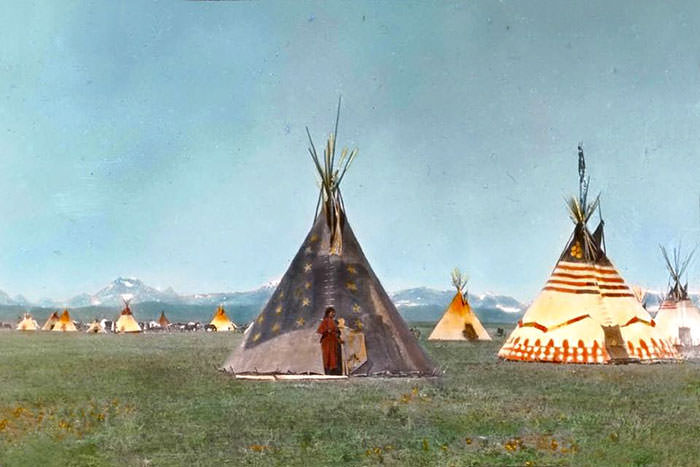
Under a wide, pale sky, a Blackfoot camp spreads across open grassland while distant mountains anchor the horizon. At the center stands the star tipi, its dark hide painted with bright, scattered stars that draw the eye from far away. A woman pauses at the entrance, creating a quiet, human scale against the tall lodge poles and the sweep of the prairie.
Colorization brings out details that often fade in older prints: the warm reds and creams on neighboring tipis, the bluish haze over the peaks, and the varied greens of the field. The star design reads not merely as decoration but as a statement of identity and meaning, hinting at the deep visual traditions within Plains tipi art. Even without a named photographer or a pinned-down place, the scene conveys the ordered rhythm of camp life—lodges set with space between, pathways worn into the grass, and a sense of community beyond the frame.
For readers interested in early 1900s Indigenous history, this photograph offers a rare, intimate glimpse of Blackfoot material culture and the landscape that shaped it. The woman’s stance at the doorway suggests everyday continuity rather than staged spectacle, emphasizing lived experience in a moment of transition for many Plains communities. As a historical photo enhanced through careful colorization, it invites closer looking—at patterns, craftsmanship, and the enduring presence of the people who made this camp a home.