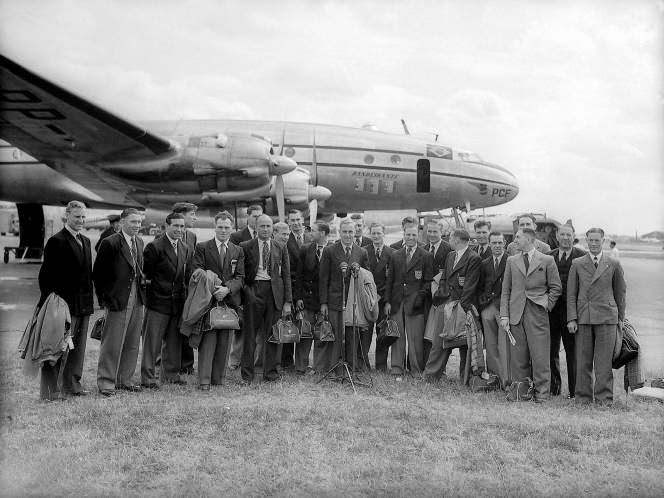
Clustered on the edge of an airfield, a smartly dressed squad gathers with coats draped over arms and small bags in hand, posing in front of a hefty propeller aircraft marked with “BRITISH EUROPEAN AIRWAYS.” The plane’s engines and broad fuselage dominate the background, underscoring how momentous international travel still felt in the early era of global football. Faces are set with a mixture of pride and concentration, as if the weight of representing a nation has already begun to settle in.
Behind the smiles and formal attire sits the larger story hinted at in the title: FIFA’s struggle to assemble a field amid bans, withdrawals, and the practical realities of distance. Long before streamlined scheduling and charter flights, simply getting teams to the host country could determine who competed, with travel costs and limited experience shaping the tournament as much as talent. Against that backdrop, England’s departure for Brazil carried the symbolic charge of a World Cup debut, a step into a truly worldwide contest.
For readers interested in football history, England at the airport is more than a team photo—it’s a snapshot of sport meeting logistics, politics, and postwar recovery. The composition highlights the rituals of departure: the group portrait, the luggage, the machine that would bridge continents, and the sense of embarking on something unfamiliar. In one frame, the beginnings of modern international football come into focus, when the road to the World Cup started not in a stadium but on a runway.