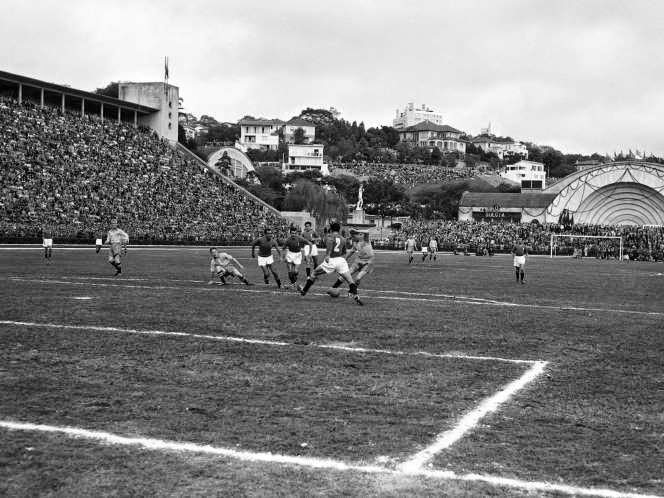
Packed terraces rise steeply behind the touchline, turning a modest hillside ground into a roaring amphitheatre as players converge on the ball near the edge of the penalty area. The scene is all urgency—tight marking, a low challenge coming in, and teammates bracing for a loose rebound—while the white-painted lines and well-worn turf anchor the moment in an era before modern stadium polish. In the background, clustered buildings and a curved-roof stand frame the matchday atmosphere that defined early World Cup football.
Reigning champions Italy arrived with an aura of invincibility, having won the previous two tournaments without losing a single World Cup match, and that unbeaten legacy weighed heavily on every exchange. Yet the title’s reminder of a squad weakened by tragedy—after the 1939 Superga air disaster—adds a sober undertone to the sporting drama, making this contest feel like more than a routine group game. Sweden’s 3–2 upset in the opening fixture, on their way to topping Group 3, stands as one of those results that puncture myths and reshape tournaments in an instant.
Moments like this help explain why World Cup history remains so compelling: dominance can look permanent until it suddenly isn’t. For readers searching football heritage, Italy World Cup champions, and Sweden’s famous upset, the photograph offers a textured window into mid-century international competition—crowds pressed close, tactics played at ground level, and pressure visible in every sprint and tackle. It’s a reminder that behind the scoreline lies a living tableau of resilience, expectation, and the thin margins that decide sporting legends.