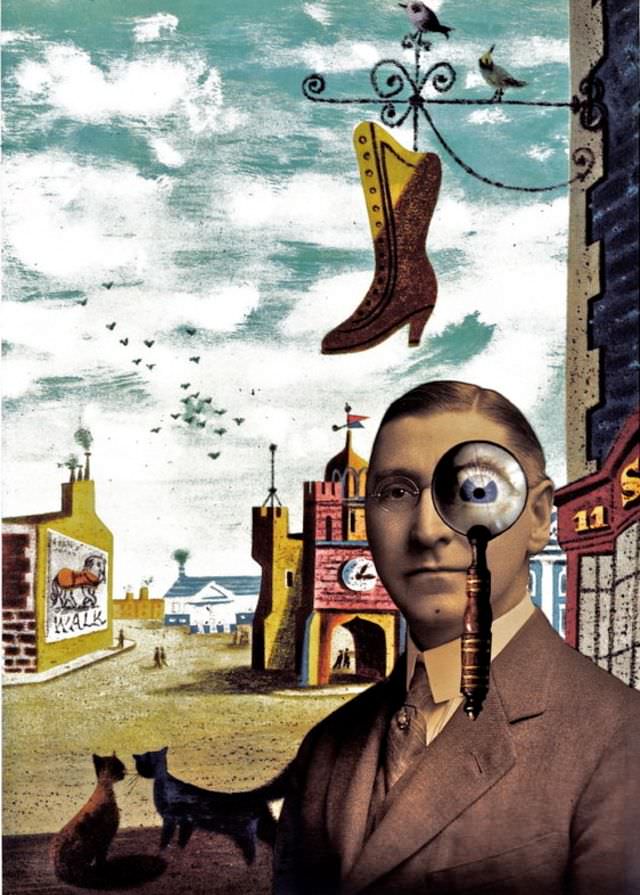
A sharply dressed figure stares out from the foreground, one eye enlarged by a dangling magnifying glass that turns simple looking into an act of scrutiny. Behind him, a stylized street recedes toward whimsical buildings, their painted facades and small silhouettes of passersby lending the scene an old-world, storybook perspective. The sky feels restless with scattered birds, as if the whole town is full of motion while the observer remains fixed, searching for meaning.
Overhead, an ornate iron bracket holds a single high-heeled boot like a shop sign, a playful detail that nudges the image toward surreal collage and early advertising design. The contrast between the formal portrait and the dreamlike streetscape suggests a world where identity is assembled from fragments—fashion, signage, architecture, and the tools of seeing. Even the animals at the bottom edge, half in shadow, act like witnesses to a private investigation happening in public.
“Nowhere Man” hangs over the composition as a lyric and a riddle: someone present yet unreachable, convinced he sees clearly while missing what’s right in front of him. That tension makes the artwork a strong fit for readers interested in visual culture, vintage illustration, and the history of photomontage aesthetics. As an SEO-friendly historical art post, it invites tags like surrealism, retro collage, street scene, and the psychology of perception—an image that keeps asking who is looking, and what is being ignored.