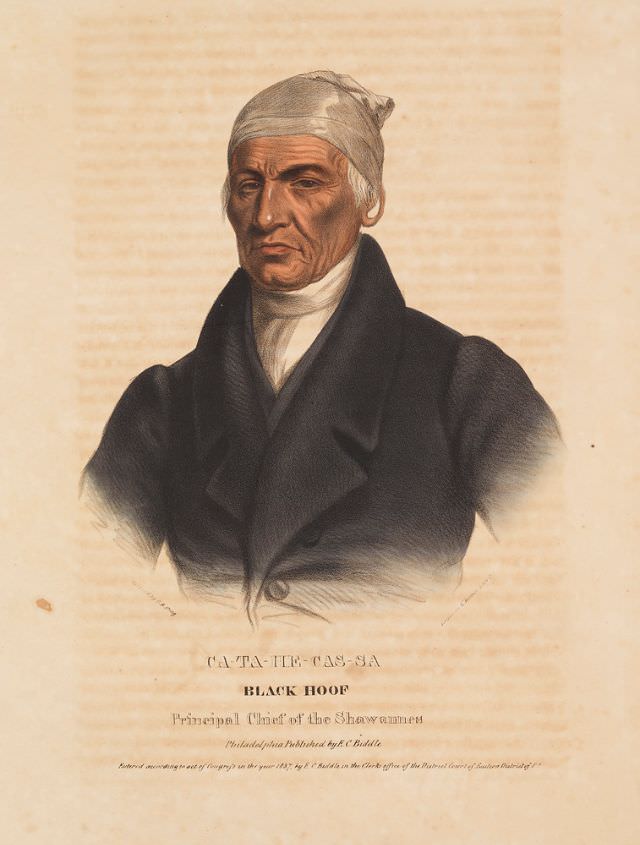
Ca-Ta-He-Cas-Sa—known in English as Black Hoof—meets the viewer with a steady, unsentimental gaze in this finely rendered portrait. A wrapped head covering frames his face, while the dark coat and high collar suggest a formal sitting meant to communicate authority as well as restraint. The soft coloring and careful shading give the print a dignified stillness, drawing attention to the lines of age and experience rather than decoration.
Beneath the figure, the caption identifies him as “Principal Chief of the Shawannes,” anchoring the artwork in a long tradition of published images that introduced Indigenous leaders to broader audiences. The composition is simple and centered, with a pale background and minimal distractions, as if the artist wanted the viewer to focus solely on character and presence. That straightforward presentation makes this piece especially useful for readers searching for historical prints, Native American portraiture, and Shawnee history through visual sources.
Viewed today, the portrait also invites questions about how such representations were made, circulated, and interpreted beyond Shawnee communities. The blend of European-style dress elements and the formal pose can be read as a record of a complex era, when diplomacy and adaptation often shaped public identity as much as tradition did. For collectors, educators, and historians, this image offers a compelling starting point for exploring the life and legacy associated with Black Hoof and the wider story of the Shawnee people.