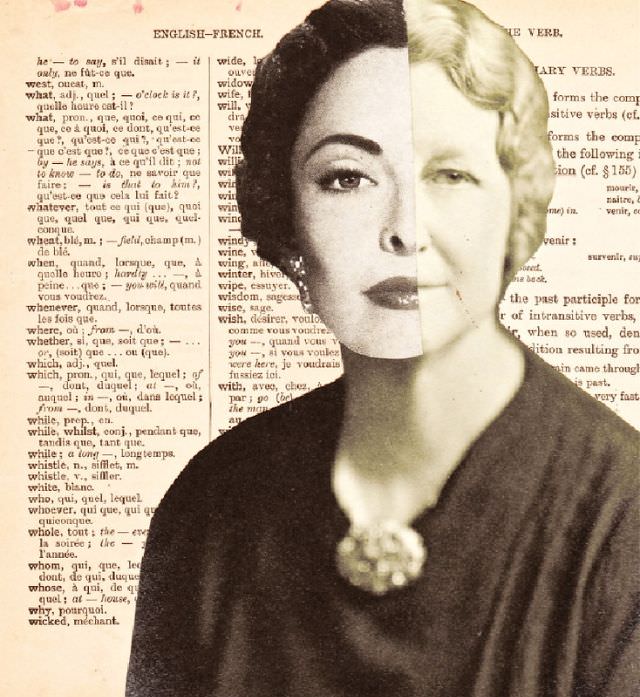
A stern yet composed woman gazes outward, her face framed by the dense columns of an English–French reference page. The background reads like a well-thumbed dictionary or textbook—snippets of “ENGLISH–FRENCH” and “THE VERB” peeking through—so the portrait feels inseparable from the classroom world the title evokes. Even without a visible schoolroom, the pairing of poised expression and printed lessons suggests authority, routine, and the quiet drama of being evaluated word by word.
Madame Pelletier, as imagined by the post title, becomes a symbol of old-school language instruction: precision, repetition, and the small gestures that signaled success. That famous arched eyebrow above the darker, dominant eye is easy to picture here—approval delivered with restraint rather than praise, a teacher’s economy of emotion. The photograph’s softened contrast and close cropping keep the focus on her gaze, inviting readers to linger on what a single look could communicate to a nervous student reciting a French phrase.
Layering a human face over grammar and vocabulary turns this historical photo into a meditation on learning itself, where identity and language overlap. For readers searching for vintage classroom imagery, French language history, or the culture of traditional teaching methods, the image offers a striking visual metaphor: instruction literally written behind the instructor. It’s a WordPress-ready piece of educational nostalgia—part portrait, part page, and entirely about the power held in pronunciation, posture, and a teacher’s measured approval.