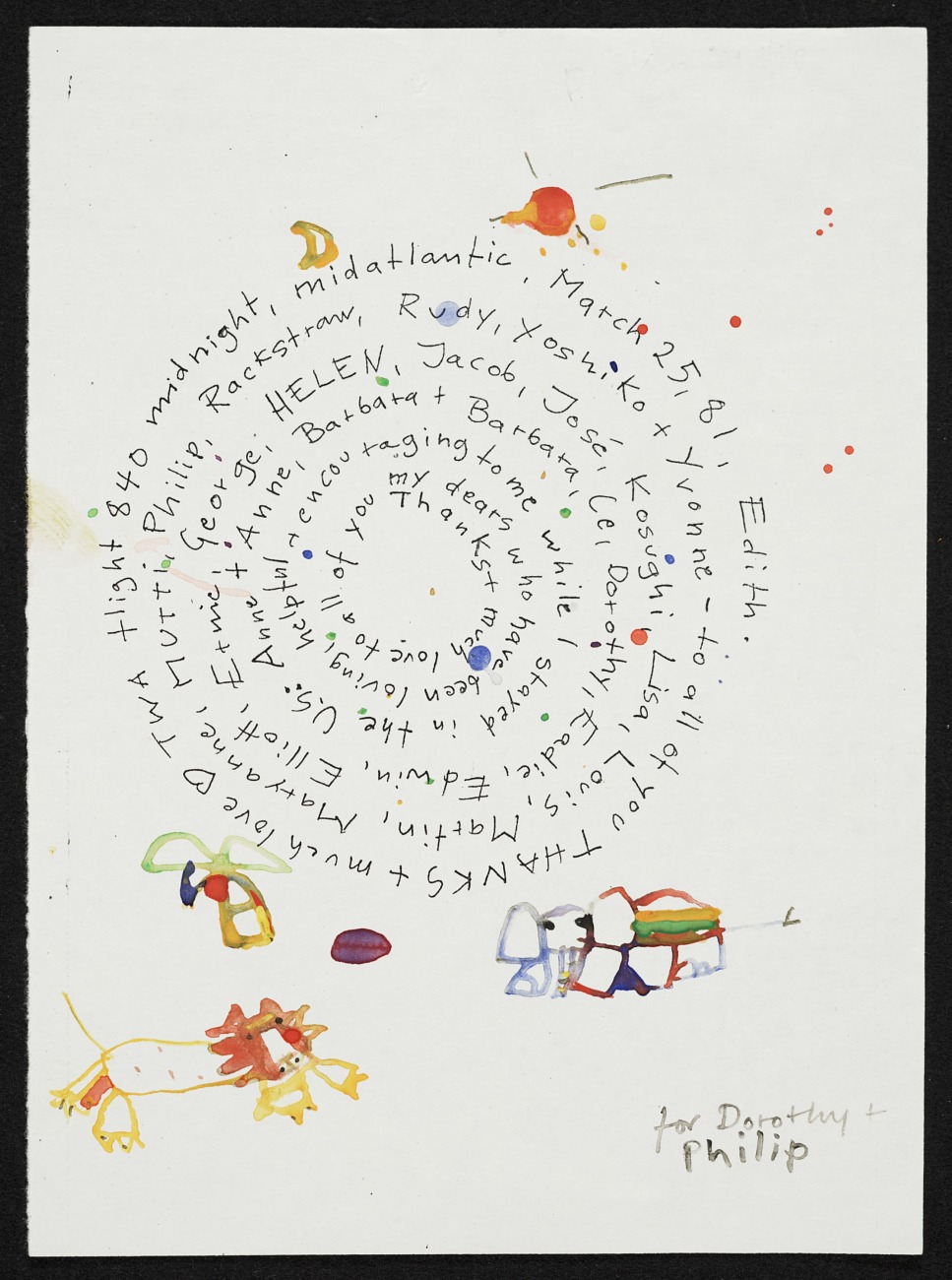
Playful handwriting spirals across the page like a message caught mid-motion, surrounded by bright splashes of watercolor and small, childlike drawings. The title, “Edith Schloss to Philip and Dorothy Pearlstein, 1981,” frames the sheet as more than a casual note: it reads as an intimate piece of mail-art, where correspondence and artwork become the same object. Along the margins, tiny figures and whimsical forms—an animal sketch near the bottom, a clustered shape at the right, and scattered dots of color—turn the white space into a lively stage.
At the center, the text curves in a loose coil, suggesting a personal letter meant to be read by turning the page or following the circle with the eye. Names and place references appear within the writing, but the overall emphasis is the gesture: ink laid down quickly, confidently, and with affection, then punctuated by spontaneous color. The composition carries the feel of an artist’s studio and the warmth of friendship, with a directness that formal portraits and polished prints rarely convey.
For readers interested in 20th-century art networks and archival ephemera, this 1981 piece offers a vivid glimpse of how artists communicated beyond galleries and exhibitions. It functions simultaneously as a document and as an artwork—part letter, part drawing, part memory preserved on paper. Whether approached as historical correspondence or as a standalone work on paper, it rewards close looking, inviting the viewer to trace the handwriting’s path and linger over each painted mark.