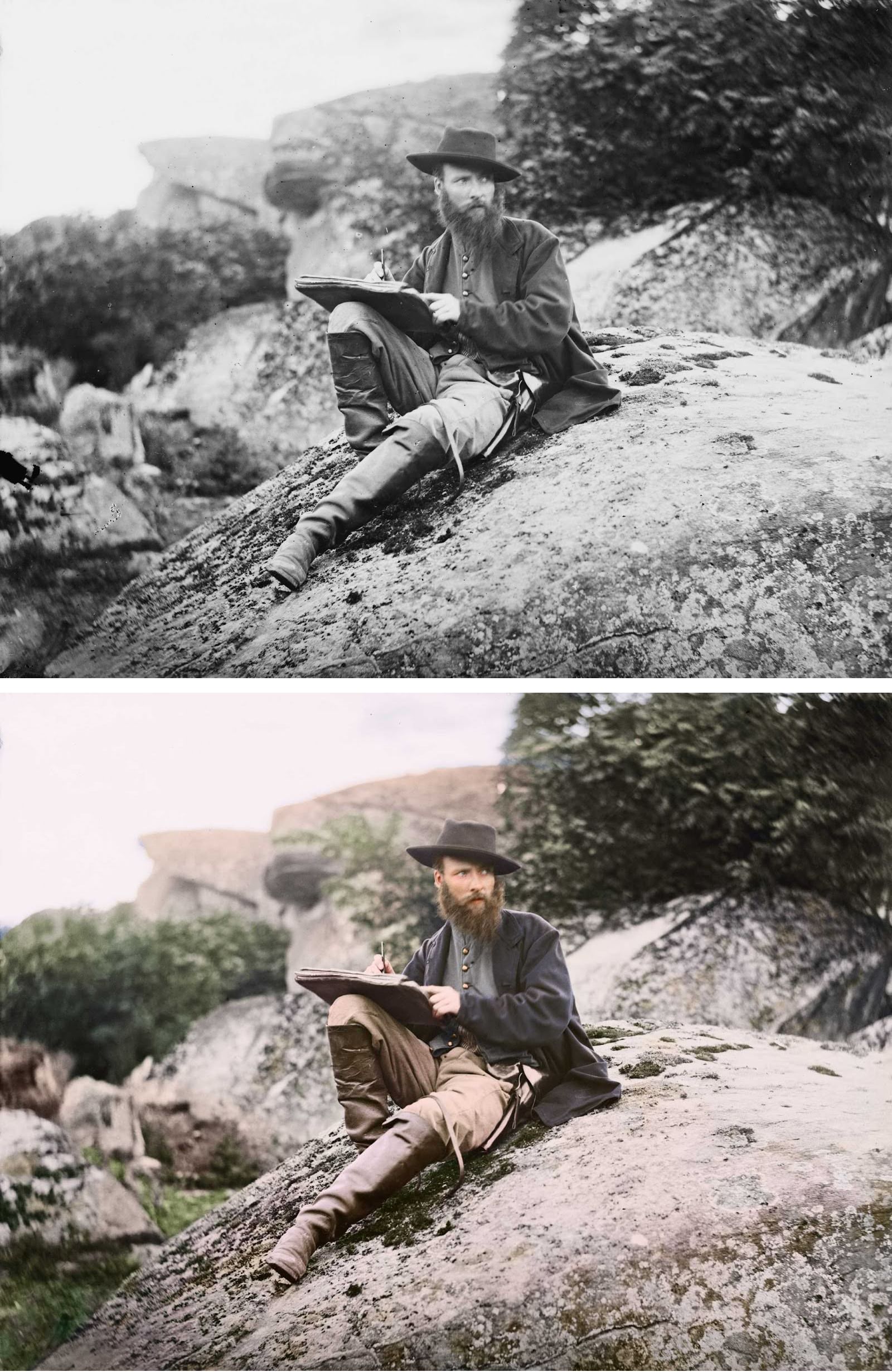
Perched on a sunlit outcrop at Gettysburg in July 1863, Alfred R. Waud pauses with sketchbook balanced on his knee, pencil poised as if the scene might change before he can catch it. His wide-brimmed hat and heavy boots speak to the rough, improvised life of a man working close to the fighting, while the rocky hillside and scrubby trees behind him hint at the unforgiving terrain that shaped the battle’s movements. The quiet focus on his face contrasts with what the title tells us about the larger moment—Civil War history being recorded in real time.
Waud’s presence matters because he was not simply observing; as an artist for Harper’s Weekly, he was translating battlefield reality into images that readers could grasp. In an era before news photography dominated the front page, sketch artists functioned as the public’s eyes, turning fleeting impressions into publishable narratives. The pose captured here—half-resting, half-working—suggests the constant tension between exhaustion and urgency that defined war reporting in the 1860s.
What lingers in this historical photo is the intimacy of the act: a single figure, outdoors, using paper and graphite to make sense of chaos just beyond the frame. The composition invites viewers to notice textures—the worn fabric of his coat, the uneven rock underfoot, the layered landscape receding into soft focus—details that ground the Gettysburg battlefield in physical reality. For anyone exploring Civil War imagery, Harper’s Weekly art, or the methods of nineteenth-century journalism, this scene offers a vivid reminder that history was often first drafted by hand.