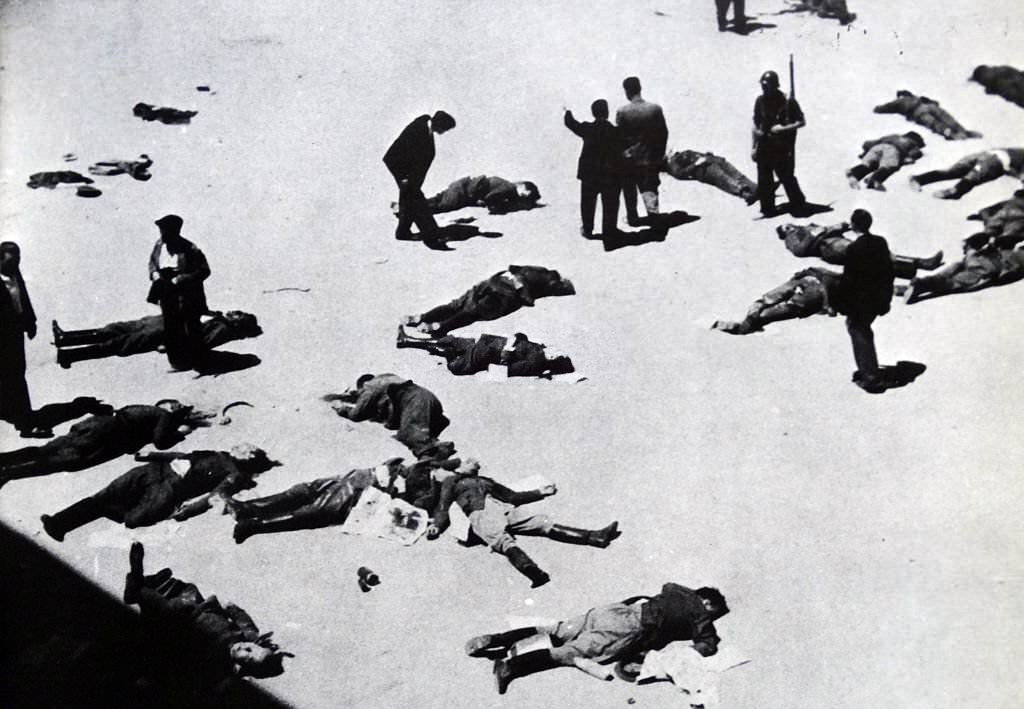
Across a wide, sun-bleached courtyard, bodies lie scattered in harsh stillness while a handful of figures move among them, pausing to look down, to gesture, to take in what the fighting has left behind. The elevated viewpoint flattens the space into a grim map of loss, with long shadows and dark clothing cutting across the pale ground. It is an unvarnished moment of the Spanish Civil War, where victory and grief occupy the same frame.
Linked to the capture of the Montaña barracks in Madrid in July 1936, the scene reflects the chaotic early days of the conflict as anti-fascist militias confronted nationalist forces associated with General Joaquín Fanjul and the military garrison. No triumphal parade appears here—only the sober work of counting the cost, identifying the fallen, and standing amid the aftermath. The absence of visible buildings or banners makes the human toll the central subject, forcing attention onto what the battle produced rather than what it decided.
For readers exploring Spanish Civil War history, this photograph serves as a stark primary witness to urban combat and its immediate consequences. The composition—open ground, scattered casualties, and small clusters of survivors—captures how quickly public spaces became battlefields and how violence reshaped daily life in Madrid. Used in a WordPress post, it anchors discussion of July 1936, the Montaña barracks, and the lived reality behind the headlines of civil wars and ideological struggle.