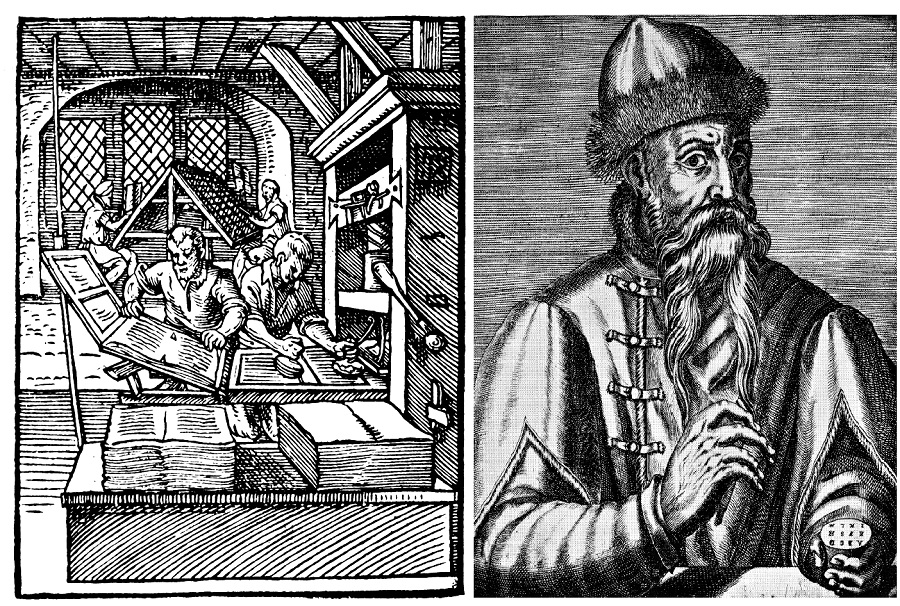
Woodcut lines and heavy shading pull you into an early print shop: workers lean over a broad press, inking and arranging pages while sheets and bound gatherings stack in the foreground. The scene emphasizes rhythm and labor—hands at the platen, eyes on the type, and the careful choreography required to turn metal letters into repeatable pages. Even without modern machinery, the illustration conveys an industrial mindset taking shape inside a modest workshop.
Alongside the shop view, a portrait traditionally associated with Johannes Gutenberg gives the invention a human face, pairing craft with ambition. The title’s “1450” signals the moment when movable type and presswork began to change Europe’s relationship with text, shifting knowledge from scarce manuscript culture toward wider circulation. For anyone searching printing press history, Gutenberg, or early modern inventions, this image encapsulates the turning point when copying by hand started to give way to mechanical reproduction.
What makes the printing press revolutionary was not a single component but a system: durable type, consistent ink, and pressure applied with repeatable force, producing pages that looked the same from one impression to the next. That standardization helped stabilize spelling, accelerate scholarship, and support the spread of pamphlets, religious works, and practical manuals. As a historical illustration for a WordPress post on inventions, it invites readers to imagine the clatter of the press and the quiet consequence of its output—ideas traveling farther, faster, and with unprecedented reach.