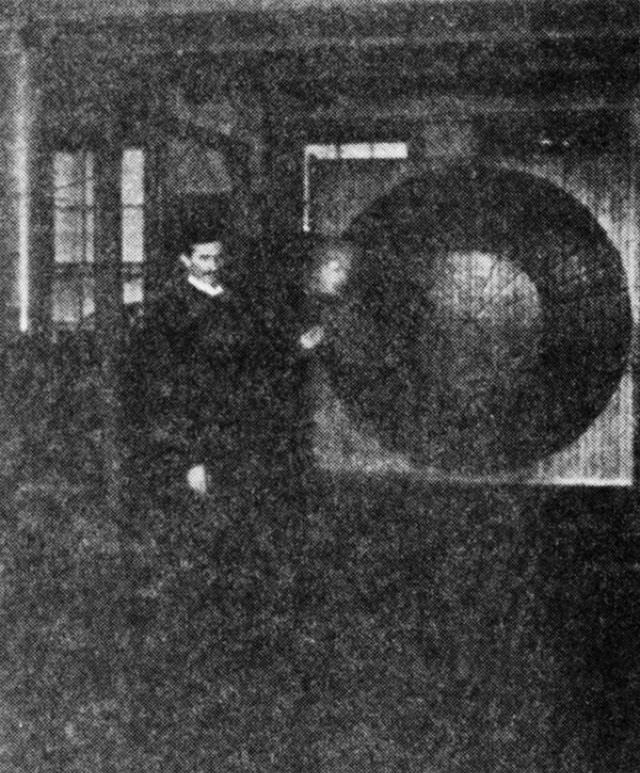
In a dim interior that feels part workshop and part stage, a lone figure stands beside an oversized circular coil mounted like a great wheel. Near the coil, an incandescent lamp appears lit—an arresting detail that turns the room’s shadows into evidence of an experiment rather than a posed portrait. The composition emphasizes contrast: dark clothing and low light set against the bright point of the bulb and the commanding geometry of the apparatus.
The title points to a bold idea from the early age of electrical invention: powering a lamp “by means of waves transmitted through space,” with the receiving coil operating “without a condenser.” That phrasing reflects the period’s fascination with wireless energy transfer and high-frequency currents, when experimenters explored how oscillations, induction, and resonance might carry power without direct wiring. Even without technical diagrams, the photograph hints at a demonstration meant to persuade the eye—if the lamp glows at a distance, then invisible waves must be doing the work.
For readers interested in the history of electricity, radio-era experimentation, and the evolution of wireless power, this image offers a compact visual narrative of ambition and uncertainty. The large receiving coil, the modest lamp, and the austere setting evoke an era when breakthroughs were often tested in plain rooms with improvised-looking rigs, long before sleek consumer devices made “wireless” feel ordinary. Filed under inventions, it serves as a reminder that many modern conveniences began as dramatic proofs of concept captured in grainy photographs like this one.