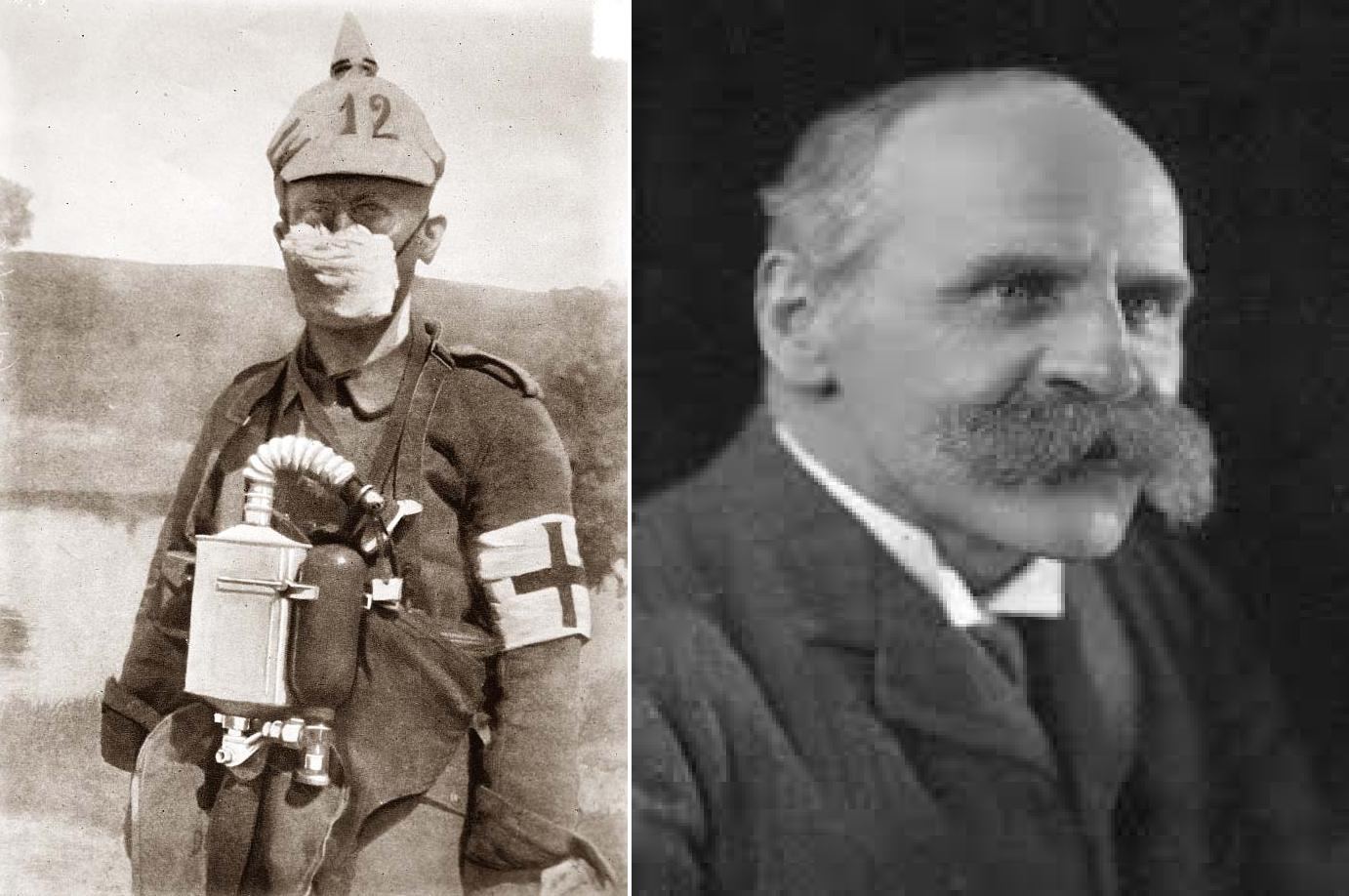
A uniformed figure stands outdoors with a cloth-like face covering and a prominent breathing apparatus strapped to his chest, its hose curling upward in a stark display of early respiratory protection. The number “12” is clearly marked on his helmet, while a bold armband with contrasting bands draws the eye to his sleeve. Practical and improvised-looking at once, the equipment suggests an era when toxic gas had become a battlefield reality and invention had to keep pace with new dangers.
Alongside this scene appears a formal portrait of John Scott Haldane, linking the human stakes of wartime survival to the scientific work behind protective gear. Haldane’s name is closely associated with the development of gas mask technology in 1915, and the juxtaposition of inventor and apparatus underscores how physiology, chemistry, and engineering converged under pressure. Even without technical diagrams, the photo conveys the fundamentals: filtration, airflow, and the urgent need to keep lungs working when the air itself turns hostile.
For readers interested in World War I innovations, the image offers a memorable entry point into the history of the gas mask—an invention that quickly evolved from stopgap measures to standardized lifesaving equipment. Details like the canister unit, harnessing, and face covering highlight the trial-and-error character of early designs while hinting at the broader story of industrial warfare and medical research. As a historical photo, it’s both a document of invention and a reminder that every improvement in protective technology was measured in breaths saved.