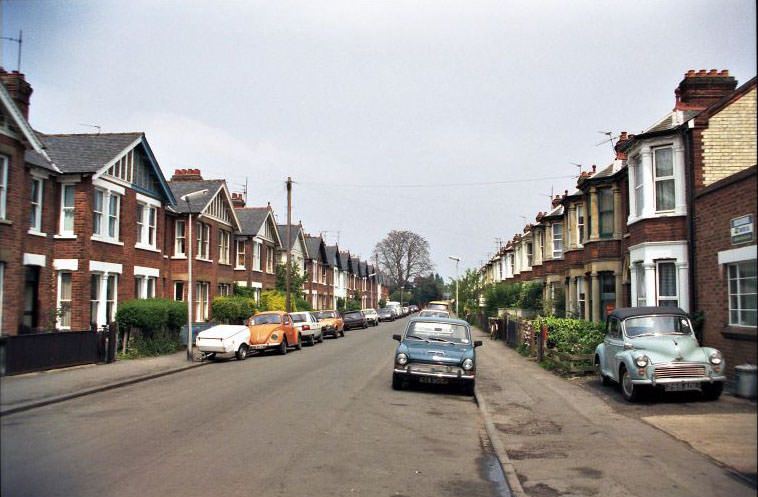
Eltisley Avenue stretches away in a long, quiet perspective, framed by two steady lines of brick terraced houses and bay windows. The street feels residential and settled, with small front gardens, low fences, and a rhythm of chimneys and rooflines that speaks to incremental urban growth rather than grand planning. Even the pale sky and soft light add to the unhurried mood, giving the scene a lived-in calm that’s instantly recognizable to anyone interested in British street history.
Parked along the kerbs, a mix of compact cars anchors the era without needing a caption, from rounded saloons to boxier family models lined up nose-to-tail. These vehicles hint at everyday “inventions” in the practical sense—mass motoring, improved manufacturing, and the design tweaks that made cars more affordable and common outside city centres. The wide carriageway, uncluttered by heavy traffic, suggests a time when residential streets still had breathing room and a slower pace.
Look closer and the details start to do the storytelling: the repeated façades broken by subtle variations, the hedges and gateposts, the lamps and overhead lines, the way the road surface and patches read as maintenance over years. As a historical photo of Eltisley Avenue, it’s less about a single event and more about continuity—how people shaped their neighbourhood through routine, transport, and domestic architecture. For readers searching for local history, vintage street scenes, or the evolution of everyday life, this view offers a grounded, relatable glimpse of the past.