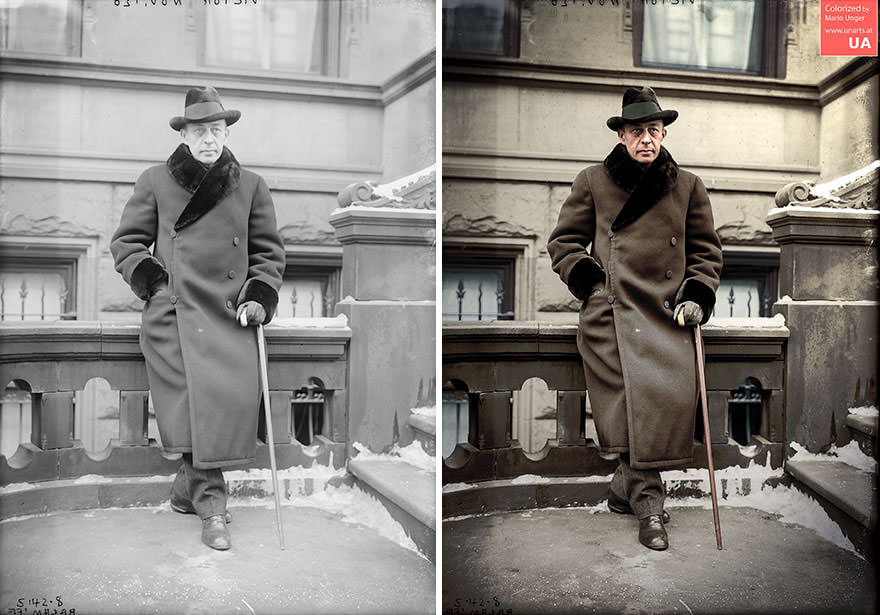
Rachmaninoff stands outdoors in winter dress, posed with a cane beside a stone balustrade, his long overcoat buttoned high and trimmed with dark fur at the collar and cuffs. A brimmed hat shadows his face, yet the directness of his gaze comes through—serious, self-contained, and unmistakably early twentieth century. Behind him, tall windows and heavy masonry hint at a grand urban building, while a dusting of snow along the ledge and ground fixes the season in place.
The side-by-side presentation of the original and the colorization invites a different kind of looking: details that read as mere tonal contrast in black and white become materials—wool, leather, cold stone—once color is introduced. Subtle warmth in the skin tones and the muted browns of the coat push the figure forward against the gray architecture, lending immediacy without changing the formality of the pose. It’s a reminder that “1915” isn’t just a date attached to a composer’s name, but a lived moment with weather, weight, and texture.
For readers searching for Rachmaninoff 1915, Rachmaninoff photo, or Rachmaninoff colorization, this portrait offers both documentary presence and a fresh visual interpretation. The cane, the careful stance, and the reserved expression suggest a man accustomed to public attention yet keeping his distance from it. Seen this way, the image becomes more than a famous face—it becomes a small window into the era’s style, atmosphere, and the quiet drama of a winter day frozen in time.