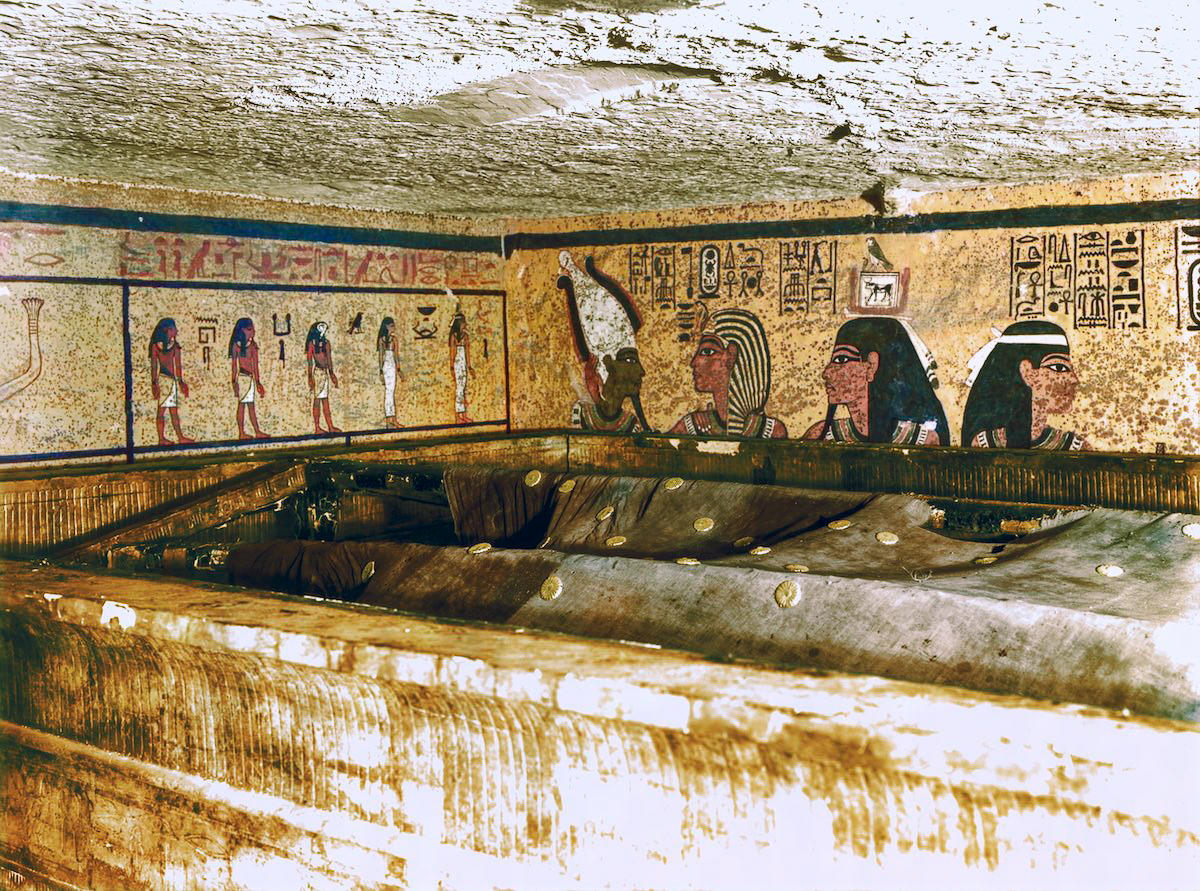
Within the cramped, sacred space of the Burial Chamber, the first (outermost) golden shrine rises like a room within a room, its gilded surfaces catching what little light could reach them. The colorization draws the eye past the shimmering framework to a linen pall spread inside the shrine’s walls, its folds lying heavily across the interior. Even at a glance, the scene communicates the layered protection so characteristic of royal Egyptian funerary practice, where precious materials and careful wrapping worked together to guard what was believed to be eternal.
Scattered across the cloth are bronze “rosettes” (Carter no. 209), small circular ornaments that punctuate the linen like stars against a darkened sky. Their placement suggests both decoration and ritual intent, turning a practical covering into an object with symbolic weight. Behind this intimate arrangement, painted figures and bands of hieroglyphs run along the chamber walls, their crisp outlines and saturated pigments made strikingly legible by the restored color—reminding us that the tomb was designed not only to conceal, but also to speak.
December 1923 marks a moment when documentation mattered as much as discovery, and catalog references such as Carter no. 207 and 209 anchor what we see to the meticulous recording of Tutankhamun’s tomb contents. The northwest corner of the Burial Chamber becomes more than a corner: it becomes a staged encounter between archaeology and ancient craft, between modern observation and a funerary world built on order, repetition, and meaning. For readers searching for Tutankhamun’s tomb photography, the golden shrine, or the burial chamber wall paintings, this image offers a vivid window into the textures and details that made the excavation so enduringly famous.