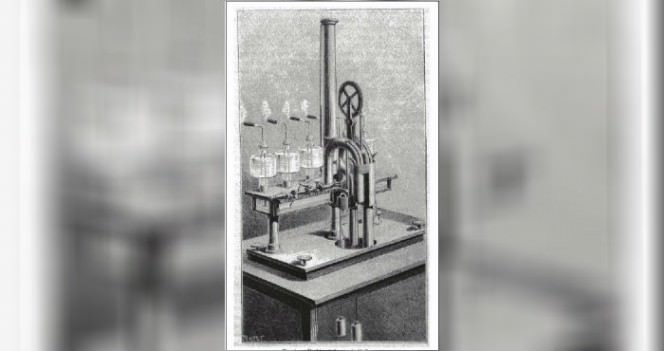
Parenty’s Smoking Machine appears as a compact industrial contraption set on a sturdy base, part workshop apparatus and part laboratory curiosity. A tall vertical column rises beside a flywheel and piping, while a row of glass vessels is aligned on a platform, each topped by a small outlet that suggests controlled delivery. The overall layout hints at an inventor’s effort to tame smoke—measuring it, directing it, and making it repeatable rather than accidental.
In the era when inventions were often demonstrated like stagecraft, devices like this promised efficiency through mechanism: valves, chambers, and gauges doing the work that hands and lungs could not. The glass jars evoke testing and calibration, as if different samples or stages of a process were being compared side by side. Whether intended for food smoking, fumigation, or another form of smoke treatment, the design points to a broader fascination with harnessing heat and vapor as reliable tools.
For readers drawn to the history of technology, this historical photo offers a vivid glimpse into how “smoking” could be framed as engineering rather than mere tradition. The machine’s clean, deliberate geometry—metal supports, vertical stack, and neatly spaced vessels—reflects the inventive mindset that sought to standardize processes for industry and science alike. As an artifact of invention culture, Parenty’s Smoking Machine invites questions about what problem it aimed to solve, and how early mechanized systems turned everyday phenomena into controlled production.