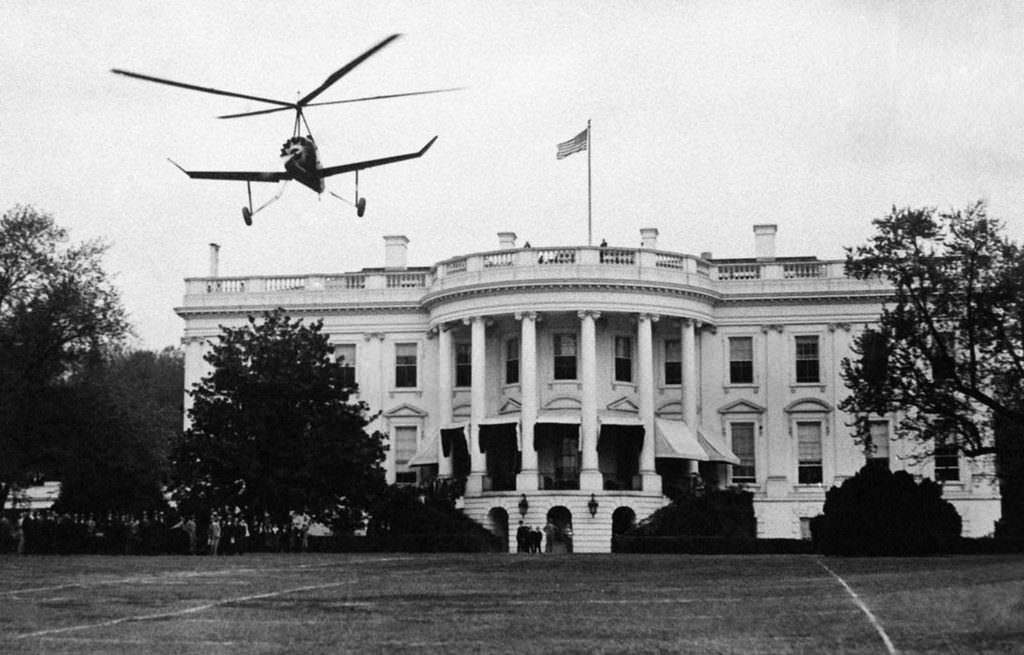
Above the familiar curve of the White House façade, an autogyro hangs in the air like a mechanical dragonfly, its rotor blades splayed wide against a pale sky. The contrast is irresistible: a daring new flying machine poised over one of the most recognizable symbols of American government. Even at a distance, the aircraft’s spindly landing gear and compact body underline how experimental early rotary-wing aviation still looked in 1931.
Autogyros—part airplane, part helicopter in the public imagination—represented a thrilling promise of controlled, slower flight, able to operate with shorter takeoff and landing demands than many conventional planes of the era. The photo frames that promise in a setting designed to be seen, turning innovation into spectacle. On the lawn below, a small crowd gathers in the shadow of trees, suggesting the kind of curiosity and awe that new inventions regularly inspired between the wars.
Set against columns, windows, and the fluttering U.S. flag, the scene reads as more than an aviation moment; it’s a snapshot of modernity courting legitimacy. Placing an autogyro in front of the White House linked technological progress with national ambition, as if the future might arrive not by train or motorcar, but on rotating wings. For readers drawn to early flight, Washington history, or the evolution of rotorcraft, this 1931 image captures the uneasy, exhilarating edge where experimentation met the public stage.