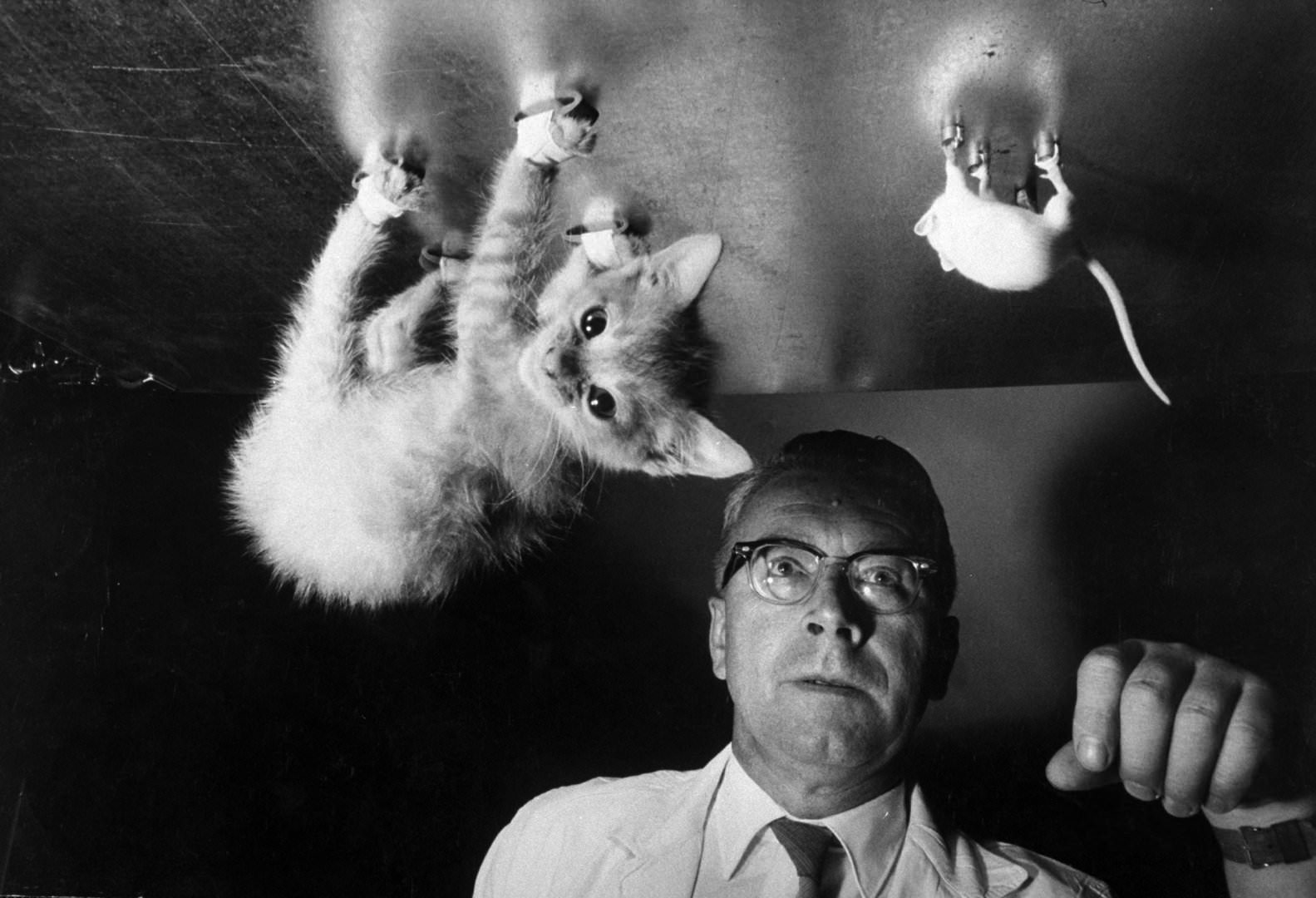
Suspended by its paws in a stark laboratory setting, a wide-eyed cat hangs upside-down beneath a row of clamps and bright lamp heads, while a bespectacled researcher in a white coat looks on from below. The contrast between the animal’s soft fur and the hard, metallic apparatus gives the scene its strange pull—part clinical experiment, part unsettling curiosity. Even without context, the composition reads like a snapshot from an era when bold questions were chased with equally bold equipment.
According to the post title, naval researcher Dr. Dietrich Beischer is testing the effects of remaining inverted for prolonged periods, using the cat as the subject. That premise places the photograph squarely in the history of military and biomedical research, when physiology under stress—orientation, balance, circulation, and endurance—was studied to understand how bodies respond in extreme conditions. The cat’s calm-yet-alert expression and the controlled lighting make the moment feel both carefully staged and oddly intimate, as if the camera briefly wandered into a world normally kept behind lab doors.
For readers drawn to unusual historical photos, this image offers a striking window into mid-century scientific culture and the sometimes uncomfortable boundary between innovation and experimentation. It’s also a reminder that “funny” and “disturbing” can share the same frame, depending on what the viewer brings to it. Whether you arrive here searching for Dr. Dietrich Beischer, naval research history, or a peculiar cat laboratory photograph, the scene lingers—because it makes you ask what question could possibly have led to this setup.