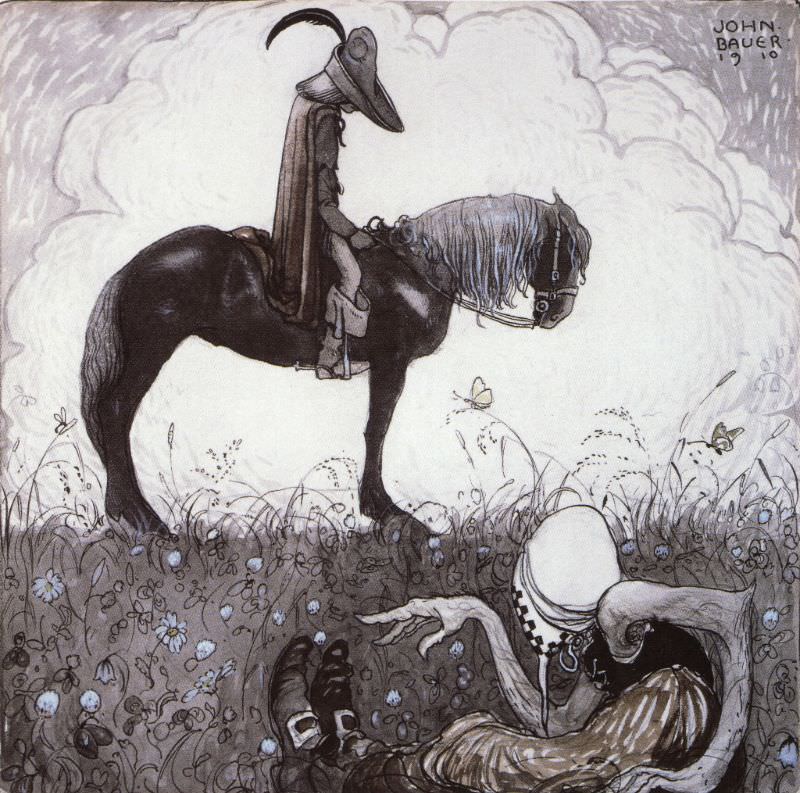
A hush seems to settle over the meadow as a dark horse stands patiently beneath a rider who looks more shadow than person, wrapped in a long cloak and an exaggerated, troll-like headpiece. Soft, clouded skies frame the scene, while wildflowers and tall grass thicken the foreground, turning an ordinary hillside into a stage for folklore. The mood is unmistakably early-20th-century fairy-tale art—restrained in palette, rich in atmosphere, and quietly unsettling.
In the lower right, a figure reclines among the blooms, one arm lifted as if to shield their face or to signal wary recognition of what passes nearby. That uneasy contrast—stillness above, vulnerability below—gives “The Troll Ride” its narrative pull, inviting the viewer to imagine what happened just before this moment and what might follow. Details like the horse’s heavy tack and shaggy mane ground the fantasy in something tactile, making the supernatural element feel all the more plausible.
As a 1910 artwork, the piece sits comfortably within a tradition of illustrated myth and legend, where trolls, travelers, and liminal landscapes blur the boundary between bedtime story and moral warning. It works beautifully as a historical art image for anyone interested in fairy-tale illustration, Scandinavian folklore themes, or the broader revival of mythic storytelling in early modern art. For a WordPress post, the title “The Troll Ride, 1910” offers strong search visibility while the scene itself rewards lingering attention, revealing new tensions in every quiet line.