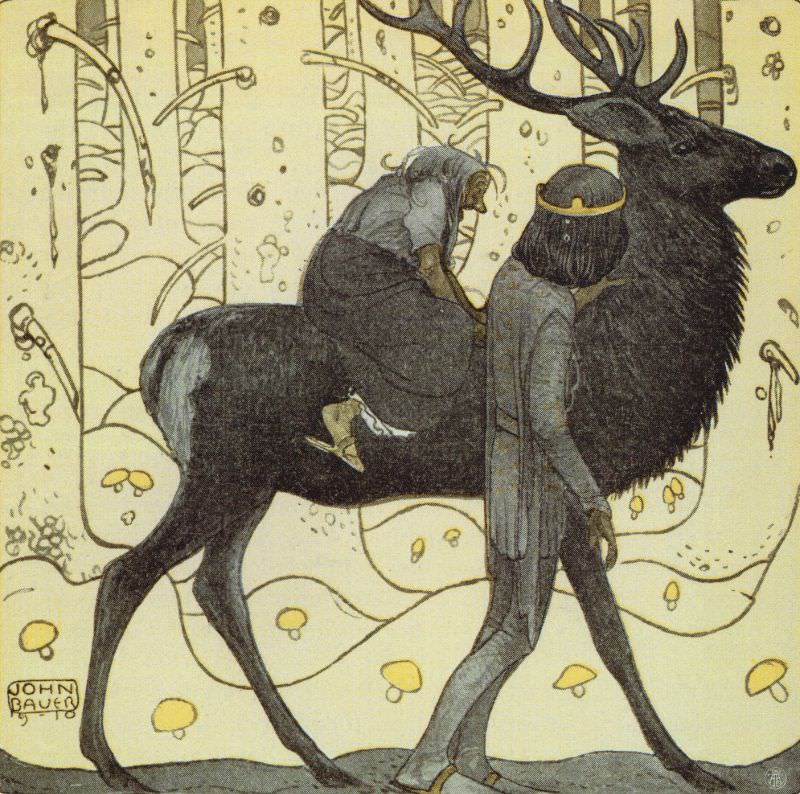
A hush of winter woods surrounds the figure of a young prince as he moves through a pale forest, led not by horse or carriage but by a towering stag. The ground is patterned with rounded drifts and small, mushroom-like forms, while the trees rise in spare, decorative lines that feel closer to storybook ornament than literal nature. Muted gold and soft gray tones lend the scene an otherworldly calm, as if the air itself has been brushed onto the paper.
The title, “The Prince Without a Shadow, 1910,” invites a reading beyond simple travel: a shadowless prince suggests enchantment, exile, or a bargain struck in silence. Here, the prince’s posture—cloaked, composed, and slightly withdrawn—contrasts with the animal’s confident stride and branching antlers, turning the stag into both guide and guardian. The stylized treatment of line and space echoes early twentieth-century illustration and print aesthetics, where symbolism often mattered as much as narrative.
As a historical artwork from 1910, this image bridges folklore and modern design, making it a compelling piece for readers interested in classic illustration, fairy-tale motifs, and the visual language of the era. The signature visible in the corner underscores its origin as a crafted print rather than a casual sketch, and the refined composition rewards close attention. For collectors and art-history enthusiasts alike, “The Prince Without a Shadow” stands as a striking example of how mythic storytelling could be reinvented on the page in the early 1900s.