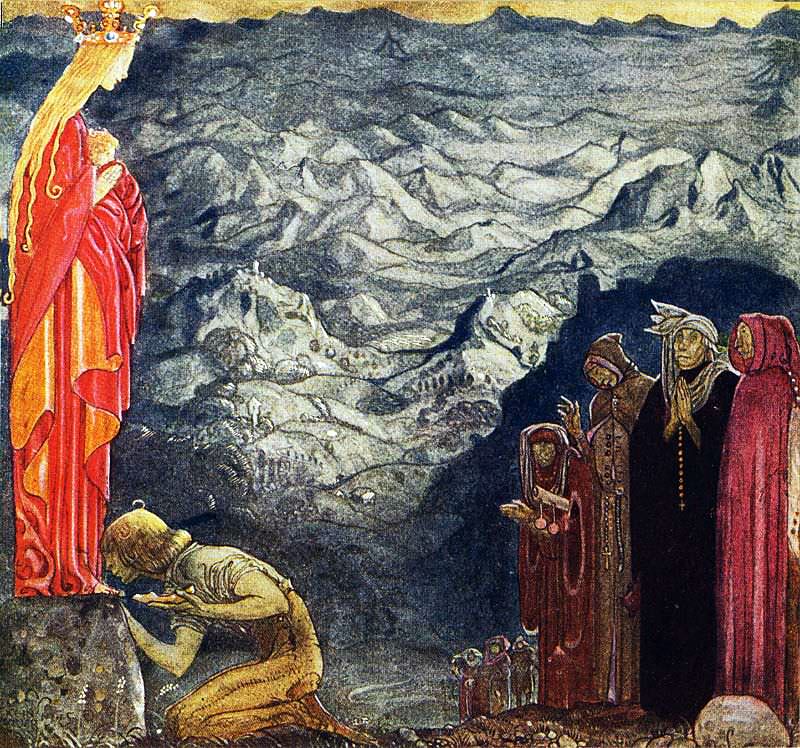
Against a sweeping backdrop of dark, layered mountains, a crowned woman in flowing red stands like a beacon at the edge of a rocky ledge, her long golden hair falling in a bright ribbon down her back. Below her, a figure kneels in a posture of humility, hands lifted toward the hem of her garment, creating an instant tension between reverence and vulnerability. To the right, a small procession of hooded onlookers gathers in the shadowed foreground, their faces turned toward the central encounter as if witnessing a sacred moment in a folk tale.
“Bland Tomtar och Troll-3, 1915” carries the unmistakable atmosphere of Scandinavian folklore, where royalty and the uncanny often share the same twilight landscape. The composition leans heavily on contrast—warm reds and golds set against cold blues and greys—so the human drama reads clearly even as the wilderness threatens to swallow the scene. Details like the layered robes, downcast expressions, and clustered spectators suggest ritual, judgment, or petition, themes that echo through fairy-tale illustration and early 20th-century story art.
As an artwork for a WordPress post, this piece offers strong visual storytelling for readers searching for Swedish fairy tale illustration, “Bland Tomtar och Troll” art, or 1915 folklore imagery. The mountainous panorama and theatrical staging invite closer looking, rewarding visitors with texture, mood, and a sense of legend unfolding in silence. Whether approached as nostalgic book art or as a window into the era’s fascination with mythic narratives, it remains a striking example of how illustration can make folklore feel immediate and real.