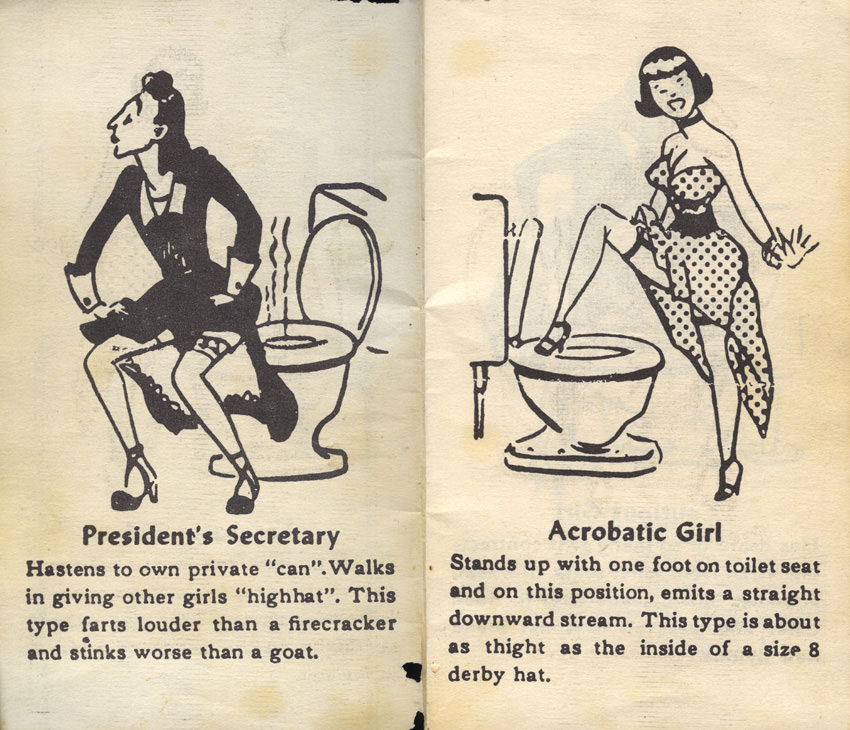
Odd little booklets like this one remind us that the past had its share of crude humor, packaged with a wink and a cartoonist’s pen. The spread titled “President’s Secretary vs Acrobatic Girl” sets up a mock rivalry between two caricatured women, each posed theatrically beside a toilet, as if staging a vaudeville contest in the most private of settings. Even without knowing the source publication, the tone is unmistakable: a deliberately “funny” gag meant to surprise, embarrass, and entertain.
On the left, “President’s Secretary” is drawn in office-like attire, knees bent and arms tensed, suggesting haste and entitlement, while the caption leans into exaggeration and insult. Opposite her, the “Acrobatic Girl” is rendered as a performer, balancing with one foot on the seat, transforming a bathroom break into a stunt. The pairing turns stereotypes into punchlines—professional respectability versus showy athleticism—using posture, costume, and labels to sell the joke at a glance.
Behind the laughter is a revealing snapshot of popular taste: gendered caricature, bathroom comedy, and the way printed ephemera could circulate risqué material under the guise of harmless fun. For readers interested in vintage humor, bawdy cartoon art, and the history of tabloid-style gags, this image offers a compact example of how everyday bodily functions were mined for shock value. It’s an uncomfortable, fascinating reminder that “funny” has always been shaped by its era—and that old jokes can tell us as much about social attitudes as they do about comedic style.