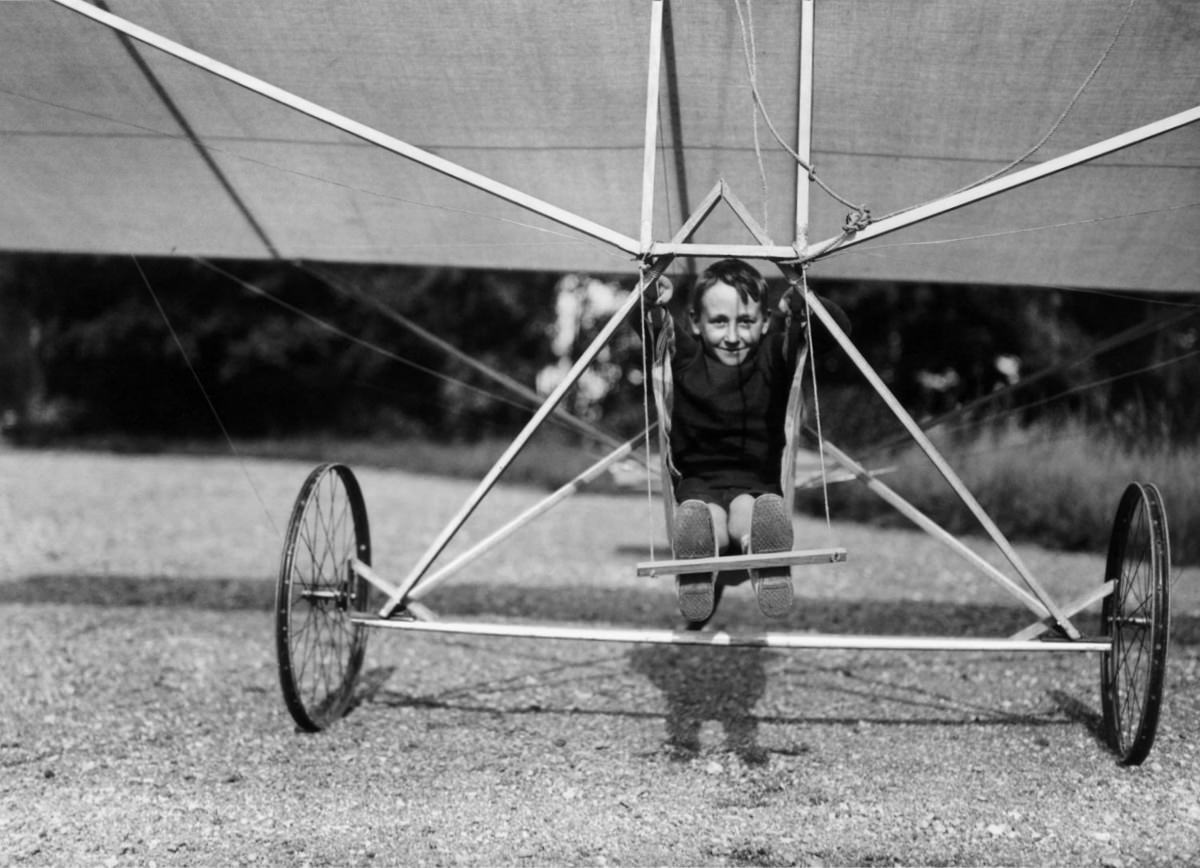
Robert sits neatly beneath a broad, taut wing, his small frame centered in a lattice of struts and wires that looks both delicate and daring. The title’s detail—“the lightest” chosen to test-fly “Pic no. 3” in Rouzat, September 1910—immediately evokes the practical arithmetic of early aviation, when every kilogram mattered and the pilot’s body could decide whether a machine would lift or fail. Set on open ground with trees blurred behind, the craft’s spoked wheels and skeletal undercarriage suggest a moment poised between workshop experiment and sporting spectacle.
What makes the scene so compelling is its blend of youth and engineering: a child-sized test pilot framed by the geometry of an early glider, feet forward on a simple seat, expression calm enough to read as confidence. The wing canopy dominates the composition like a portable sky, while the bracing cables form a web that hints at the constant tension these pioneers managed—literally in their rigs and figuratively in their ambitions. Even without motion, the photo communicates the quiet ritual of a trial run: positioning, balance, and the breath before release.
For readers interested in early 20th-century athletics and aviation history, this image underscores how closely sport, invention, and public curiosity intertwined in the years before powered flight became routine. “Pic no. 3” feels like a prototype in a series—an incremental step in a local tradition of experimenting with lift, stability, and lightweight design. As a historical photograph from Rouzat in 1910, it offers an SEO-rich window into vintage gliding, pioneer aircraft construction, and the human stories behind early flight testing.