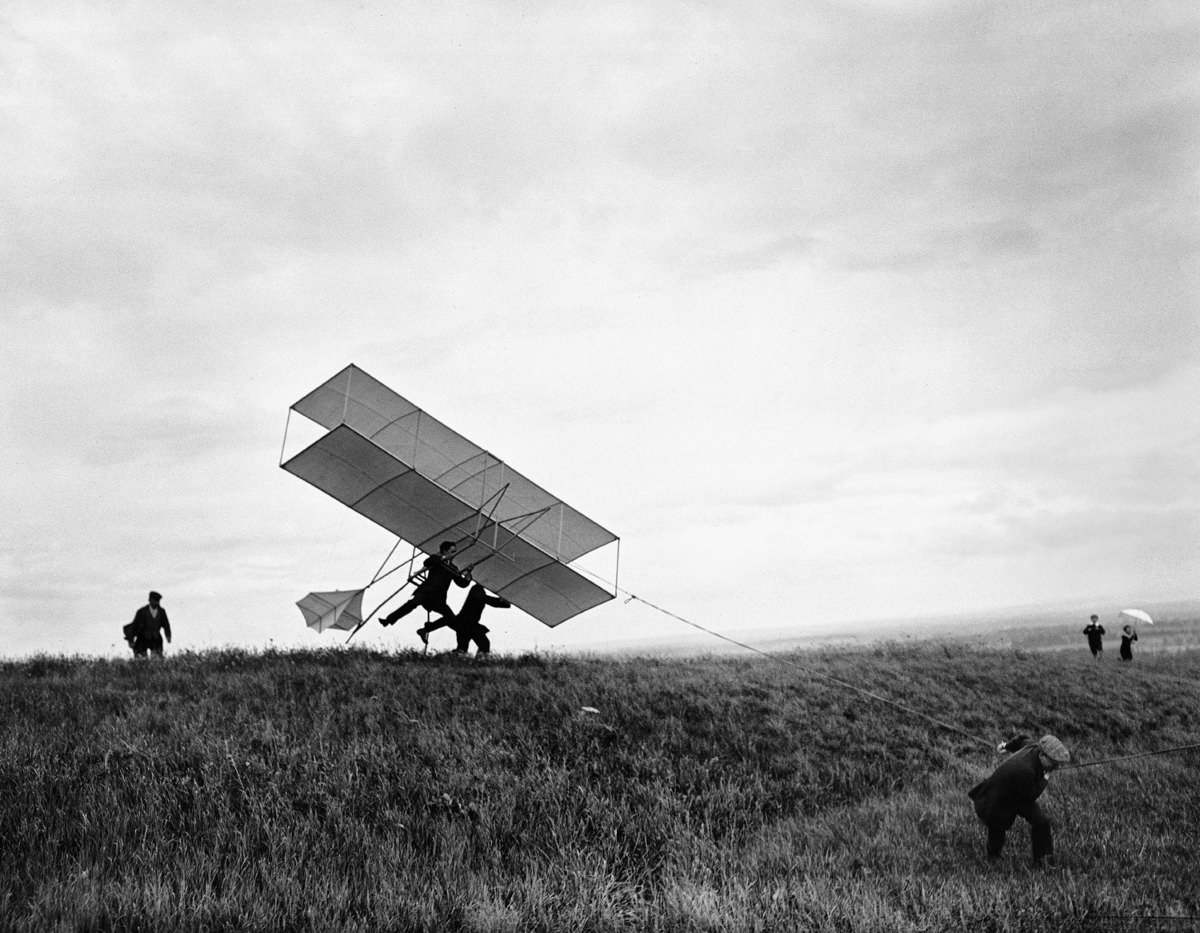
Against a wide, pale sky, the ZYX24 skims the crest of a grassy rise at Rouzat in September 1910, its boxy wings held up by a lattice of struts and tensioned lines. Several figures run in step beneath and beside the craft, their bodies angled forward with the urgency of a launch, while others dot the slope at a distance like quiet witnesses. The scene balances delicacy and daring: a fragile frame of fabric and wood poised above uneven ground, momentarily convincing the air to cooperate.
Piroux, Zissou, Georges, Louis, Dédé, and Robert—named in the title—read less like spectators than like a team, each person’s position suggesting a role in the attempt. One man braces and pulls at a line downhill, another keeps pace near the wing, and the long tether draws the eye across the hill, emphasizing how early flight depended on coordinated muscle as much as engineering. Even the open landscape matters here, offering both runway and risk, a natural stage for experiments that blurred sport, science, and spectacle.
For readers searching early aviation photography, pre–World War I flight experiments, or the spirit of early 20th century athletics, this image delivers an immediate sense of what “attempt” meant in 1910. There is no polished airfield or sleek fuselage—only a determined group, a simple machine, and the gusts over a rural ridge. It’s a vivid reminder that progress often begins as a communal sprint, with history made in the space between a few running strides and a brief, hard-won lift.