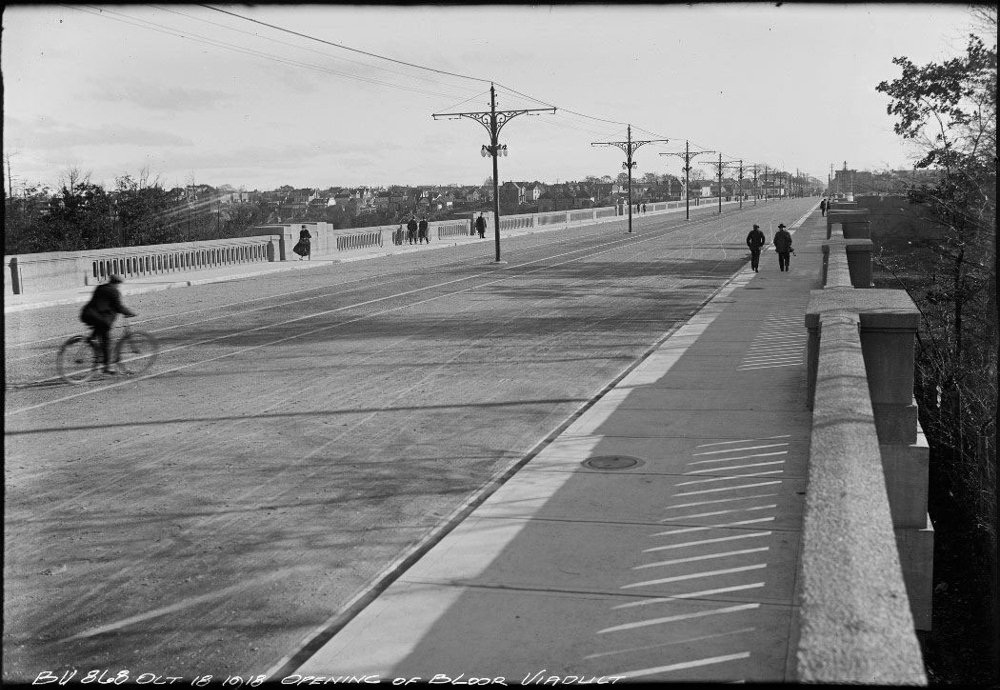
Fresh concrete and long sightlines define the new Bloor Viaduct in 1918, a broad span still quiet enough that individual travellers stand out against the open roadway. A lone cyclist blurs past in the foreground, while scattered pedestrians keep to the wide sidewalk beside the sturdy stone railing. Overhead, streetcar poles and wires march into the distance, promising a modern cross-town connection even as the bridge settles into daily use.
What makes the scene memorable is its sense of scale: the viaduct’s generous lanes, repeating light standards, and clean edges create a corridor that feels built for speed and confidence. The bicyclist’s motion—captured mid-dart—hints at how quickly Torontonians embraced cycling as practical transportation, not merely recreation. At the same time, the small clusters of walkers suggest an opening-day curiosity, a public eagerness to experience a new landmark from close range.
For readers exploring early 1900s cycling in Toronto, this photograph anchors the story in infrastructure as much as in sport. The Bloor Viaduct’s fresh geometry frames a moment when bridges, streetcar lines, and bicycles shared the same evolving streetscape, shaping commutes and weekend rides alike. Look closely and the image becomes more than a view of a bridge—it’s a snapshot of a city learning to move in new ways.