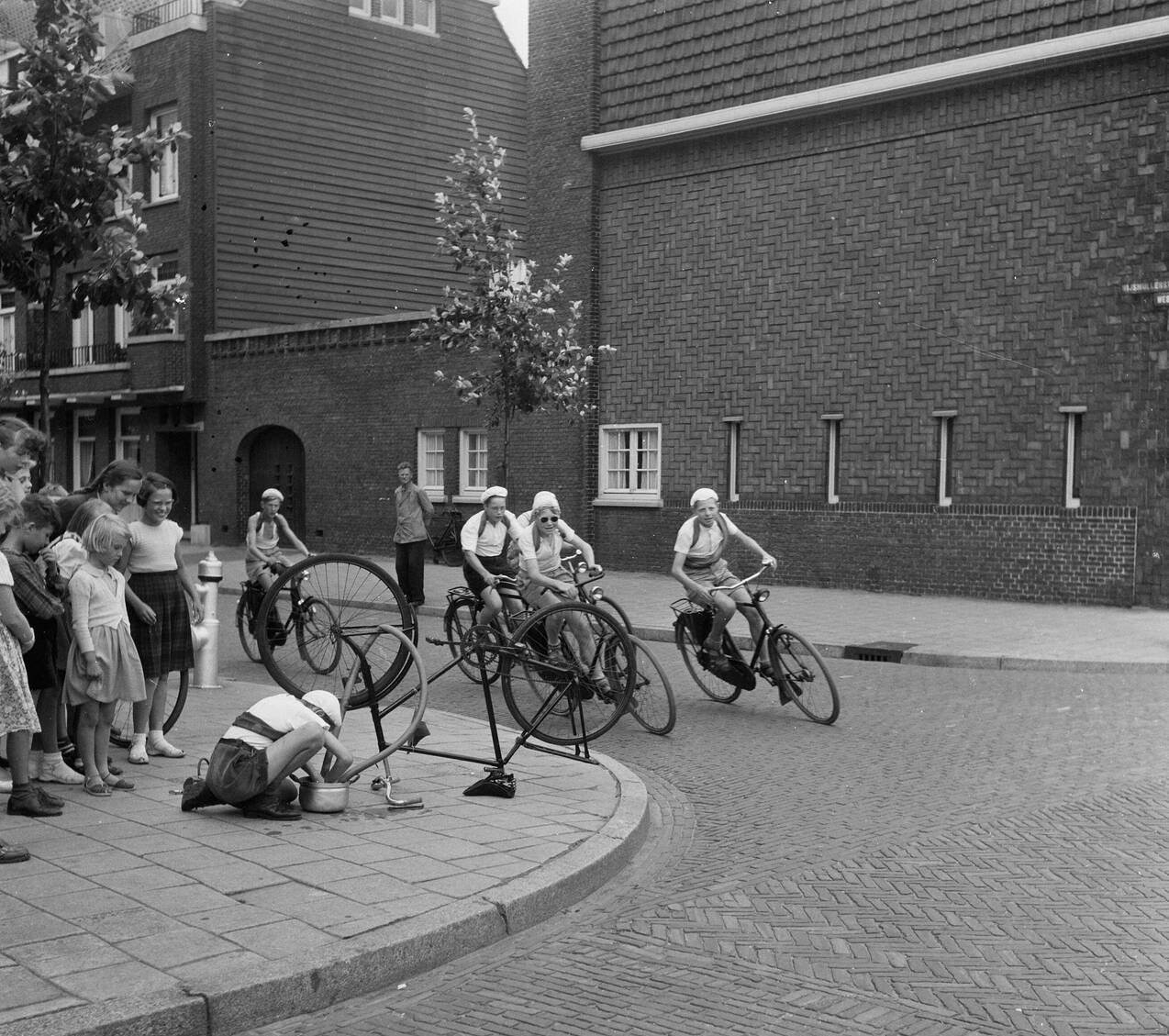
Late-afternoon light falls across a quiet street as a small crowd of children gathers on the curb, eyes fixed on the action. In the foreground, a boy crouches beside an upturned bicycle, hands busy with the sort of roadside repair every young rider learns sooner or later, while a pot or bucket sits ready like a mechanic’s toolkit. Just beyond him, other boys pedal past in caps and simple summer clothes, leaning into the curve as if it were a mountain descent.
The title points to the Tour de France in 1953, and the charm here is how the world’s greatest race is echoed at neighborhood scale. Without uniforms or banners, these youngsters recreate the drama they’ve heard about—breakaways, mishaps, and quick fixes—using ordinary bicycles and sheer imagination. The onlookers, smiling and attentive, turn the sidewalk into grandstands, transforming a residential corner into a stage for youthful competition.
Brick facades and patterned paving set the scene firmly in postwar Europe, when cycling was both practical transport and a national obsession. Details like the wire baskets, sturdy frames, and close-knit street life make the moment feel immediate: sport not as spectacle in a stadium, but as everyday culture spilling into public space. For readers drawn to Tour de France history, vintage cycling photos, and 1950s street scenes, this image offers a lively reminder that legends often begin with games played close to home.