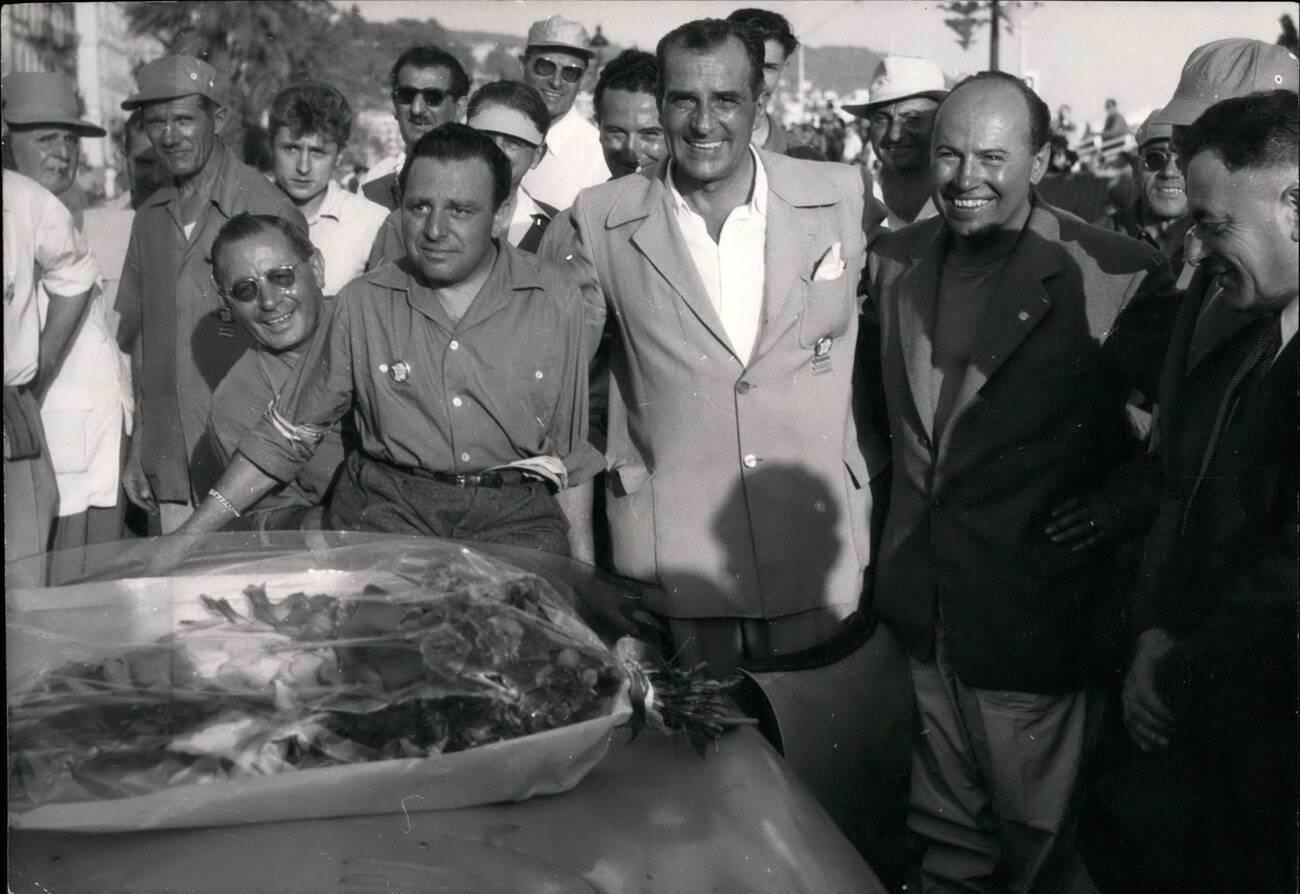
Raymond Bertram stands at the center of a jubilant knot of faces, smiling as the crowd presses in close around him after the Tour de France Motor Car race in 1953. The mood is informal and immediate—rolled sleeves, sunlit expressions, and the kind of relaxed posture that comes only once the pressure of competition has passed. In the foreground, a bouquet sprawls across the car’s hood, turning the machine of speed into a makeshift podium.
Around Bertram, friends, organizers, and onlookers cluster shoulder to shoulder, some leaning in as if to claim a place in the moment. The car itself is mostly out of frame, yet its curved bodywork and the placement of flowers signal the finish-line ritual: victory acknowledged not only with results, but with public celebration. Details like caps, sunglasses, and light jackets hint at the era’s everyday style, grounding the triumph in the lived texture of the early 1950s.
For readers searching motorsport history, this photograph offers more than a winner’s portrait; it captures the social theater of postwar racing, when endurance, reliability, and daring were celebrated with equal enthusiasm. The Tour de France Motor Car race demanded teamwork as much as talent, and the gathered group suggests a shared achievement as well as an individual one. As a historical sports image, it preserves the instant when Bertram’s name became inseparable from a hard-earned 1953 victory.