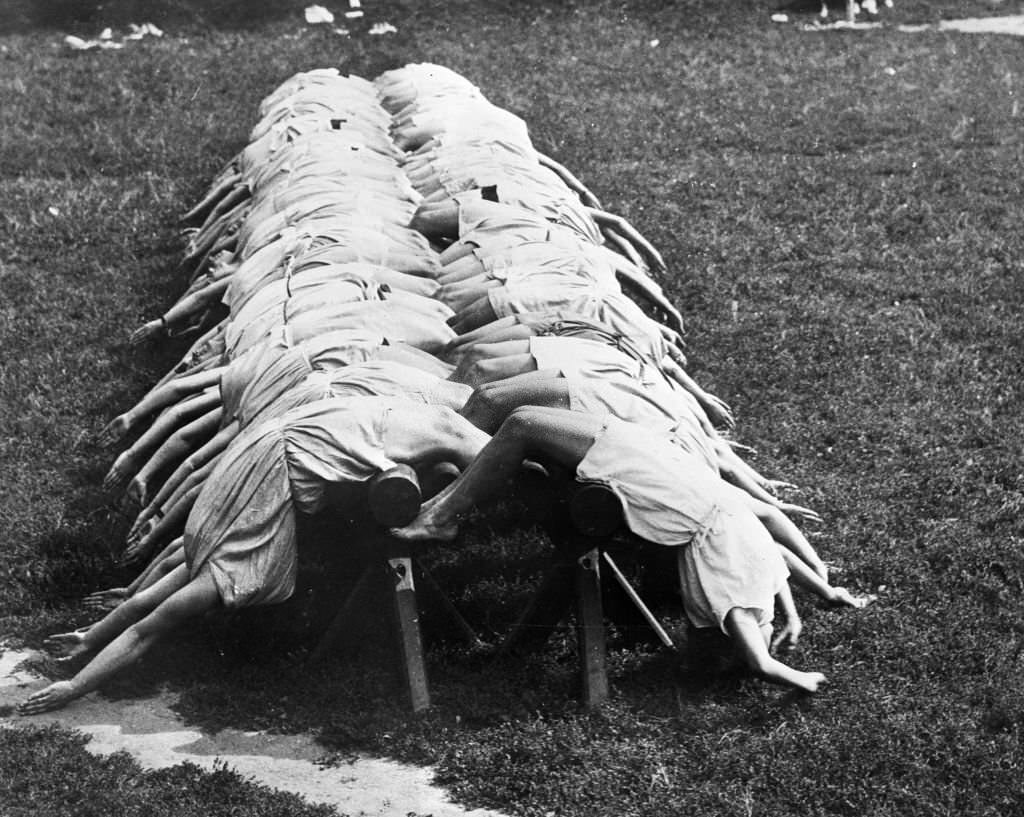
Rows of women lean forward in unison over a low training apparatus set on a grassy field, their bodies forming two long, disciplined lines. The pose looks almost choreographed—arms stretched down, torsos folded, legs braced—suggesting a demanding drill that valued uniformity as much as strength. Seen today, the scene belongs naturally among “weird exercise machines and workout methods from the past,” where fitness often meant endurance through rigid form.
According to the title, this was a demonstration of one of the difficult training practices required of French women school teachers at a Government Physical Training Institute just outside Paris. Teacher training here wasn’t confined to classrooms and lesson plans; it extended into organized physical culture meant to shape posture, stamina, and self-control. The equipment itself feels starkly practical—more like a tool for enforcing alignment than anything resembling modern gym comfort.
What lingers is the contrast between the quiet outdoor setting and the intensity implied by the drill, a snapshot of how education, public health, and sport could overlap in institutional life. The photograph also hints at the period’s faith in standardized routines: bodies trained together, movements repeated together, and a collective ideal of preparedness carried back into schools. For readers interested in French physical education history, early fitness regimens, or the social expectations placed on women educators, this image offers a vivid, unsettling window into the past.